How electron spins can boost computing
You wake up late. Your assignment is due in two minutes. You grab your laptop with a standard 8 or 16 GB RAM, a 512 solid state drive (SSD) that is “supposed” to be fast, a decent processor that usually gets the job done. You press the power button. The screen lights up … slowly. The system begins its familiar ritual – boot sequence, background processes, apps waking up one by one. The fan starts spinning, a faint whir growing louder. You’re staring at the loading screen, watching seconds slip away. By the time your desktop appears, you rush to open your document. The cursor lags for a moment. The file loads. You hit “Send.”
Alas! Deadline missed.
Somewhere in the background, billions of electrons have rushed through circuits, colliding, dissipating energy as heat, doing their job, but inefficiently, noisily, wastefully. Now imagine a laptop with no heat buildup and no energy wasted moving charge back and forth. Just quiet, near-instant computation. One day, this might be possible – using spintronics. Spintronics (spin+electronics) is a field that exploits the electron’s spin, in addition to its charge, to process and store information. The electron is not a “spinning” ball, rather spin is an intrinsic quantum property that makes electrons behave like tiny magnets.
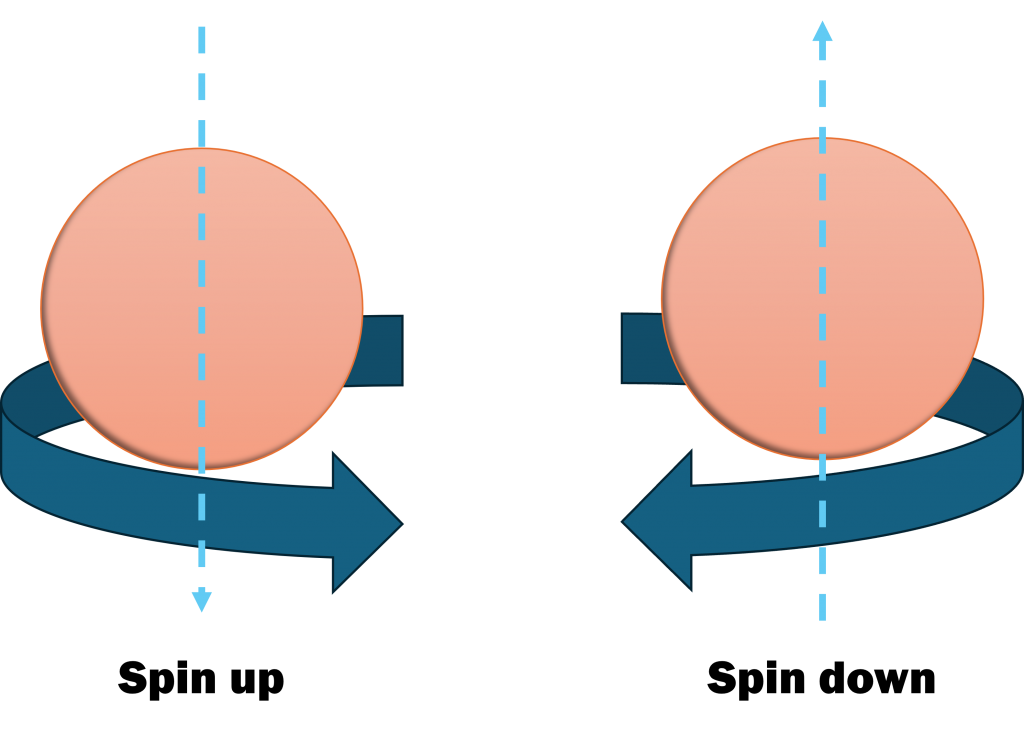
If you measure how an electron responds to a magnetic field, you will find that the electron exists in one of two orientations – aligned in the same direction as the field (up) or aligned against it (down). “Up” and “down” are two possible states of an electron’s tiny built-in magnet, like north or south in a compass. These states can represent binary information, much like the 0s and 1s used in computers. Spintronics uses this binary information to enable new ways of computing, allowing devices to be faster, energy-efficient, and non-volatile (retaining charge even when power is turned off) compared to conventional electronics.
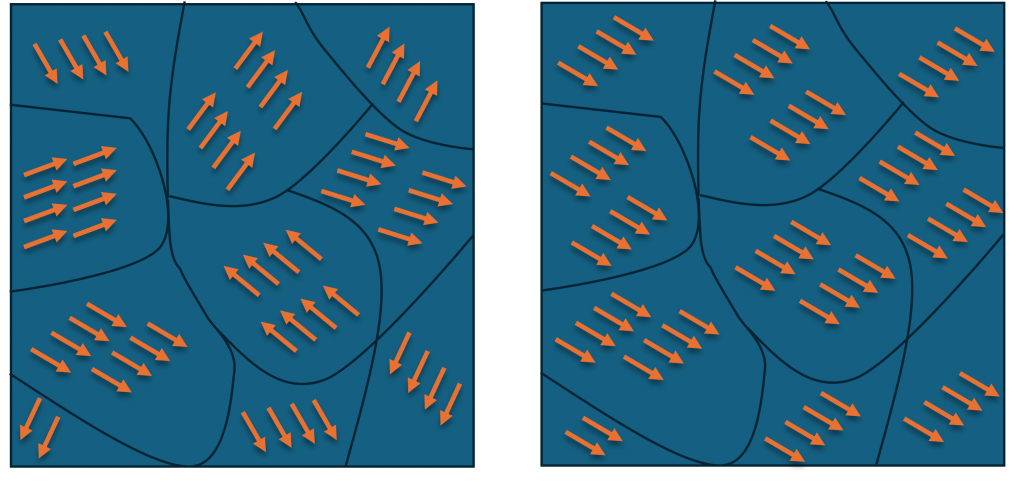
In everyday materials, the electron spins point in random directions, cancelling each other out. But in ferromagnetic materials used in spintronics devices, like iron, cobalt, or nickel, many of these electrons naturally align in the same direction – some of them can be “spin up” and some can be “spin down”. This creates a flow of electrons that carries both charge and spin information.
Spintronics has already made its way into some of the technology we use every day. Our phone’s digital compass relies on a magnetometer built on spintronic principles. Wheel speed detection in anti-lock braking systems (ABS), which play a critical role in vehicle safety, uses spintronic sensors.
Now, as conventional computing grapples with a growing energy crisis where faster processors demand more power, generate more heat, and rely on increasingly inefficient memory systems, scientists are increasingly turning to spintronics. Having seen it evolve from a strange quantum mystery to a Nobel-winning breakthrough, many now believe spintronics could reshape the future of computing itself.
From bad cigars to iPods
The story of spintronics began with a simple question – does the electron have more to it than just charge? In an experiment in the early 1920s, German physicists Otto Stern and Walther Gerlach passed a beam of silver atoms through a non-uniform magnetic field. The beam split into two distinct paths, defying classical expectations and hinting at quantised behaviour. The splitting deposited tiny amounts of silver onto a detection plate but they were invisible. In a twist of serendipity, Stern’s cigar smoke helped reveal the result.
“My salary was too low to afford good cigars, so I smoked bad cigars. These had a lot of sulphur in them, so my breath on the plate turned the silver into silver sulphide, which is jet black, and so easily visible,” Stern is quoted as saying, as recounted by Dudley R Herschbach in his Nobel lecture on molecular dynamics of elementary chemical reactions. Stern described it as being ‘like developing a photographic film.’
The result was so striking that Gerlach immediately wrote to Danish physicist Niels Bohr, suggesting that it supported emerging quantum theory, though no one could yet explain why only two beams appeared. As physicists debated explanations, Austrian-Swiss theoretical physicist Wolfgang Pauli introduced his exclusion principle, the idea that no two electrons in an atom can occupy the exact same quantum state. He proposed that electrons must possess an additional unknown quantum property. In 1925, Dutch-American physicists George Uhlenbeck and Samuel Goudsmit finally solved this mystery, proposing that this unknown feature of an electron could be its “spin” – an intrinsic form of angular momentum that gives rise to two allowed orientations in a magnetic field (corresponding to the two beams).
At the time of its discovery, the idea of a “spinning” electron left even Pauli’s head spinning as it seemed to make little physical sense, yet the concept held firm and became a cornerstone of quantum mechanics. A major turning point came in 1988, when Albert Fert and Peter Grünberg discovered giant magnetoresistance (GMR), for which they won the Nobel Prize in Physics in 2007. They showed that the relative alignment of electron spins can dramatically affect the electrical resistance of a material. This meant that an electrons’ spins could directly control electric currents and electronic signals, which transformed spin from a theoretical curiosity into a practical tool for technology. Building on this, the term “spintronics” was coined in the late 1990s by researchers at IBM, particularly Stuart Parkin.
The GMR effect enabled a 100–1000 times increase in storage per inch of hard disk drives, driving the miniaturisation of modern data storage technologies. “You would not have an iPod without this effect,” Borje Johansson, member of Royal Swedish Academy of Sciences (RSAS) said to The Guardian in October that same year.
“GMR is the one of the fastest discoveries to transition to the market,” says PS Anil Kumar, Professor in the Department of Physics, IISc, who set up one of India’s earliest spintronics labs at the Institute.
Laying the foundations
Spintronics is built on three core ideas: how materials create and align electron spins (magnetism), how those spins move through materials (spin transport), and how they can be controlled using electric fields (spin-orbit effects).
Some of the theoretical groundwork for these ideas were being explored as early as the 1970s in IISc. KP Sinha and his young collaborator Narendra Kumar, who joined the Institute around 1972 at the invitation of the then Director Satish Dhawan, helped build a strong foundation in magnetism and electronic transport. Around the same time, a young PhD fellow at the Department of Applied Mathematics, G Baskaran, was drawn into physics after attending Kumar’s lectures. Baskaran joined Sinha and Narendra, in their exploration of how magnetic excitations, known as magnons, interact with collective electronic behaviour in materials.
Published in the journal Pramana of the Indian Academy of Sciences in 1973 and reviewed by Hannes Alfvén, 1970 Nobel laureate in physics, their study on magnons interacting with electrons (titled ‘Plasmon Magnon Interactions in Magnetic Semiconductors’) was initially seen as a negative result because the interactions were very weak. “Since I found the interaction to be weak, I used to tell my friends jokingly that I’m working on weak interactions,” says Baskaran (a pun on the weak nuclear force, one of nature’s four fundamental forces studied in particle physics). But four decades later, with advances in 2D materials and experimental techniques, such theoretical formulations gained recognition. “Unfortunately, Sinha is not around to enjoy that,” Baskaran adds.
Kumar and Sinha helped lay the groundwork for faculty member TV Ramakrishnan, who joined IISc in 1986. He played a key role in shaping the Department of Physics, with influential contributions to the understanding of electron localisation in disordered systems, which are materials in which impurities, defects, or randomly arranged atoms disrupt the regular crystal structure and alter how electrons move. By understanding how disorder affects spin orientation, researchers can design better materials for spintronics devices.
Advances in materials science have been equally critical. CNR Rao, former Director of IISc, explored transition metal oxides and magnetic materials, significantly expanding the range of systems in which spin-dependent phenomena could be explored.
Together, these early studies in magnetism, electronic transport, and materials science created the scientific foundation on which modern spintronic devices are being built today.
Building an ecosystem
In 1999, Anil Kumar, then a postdoctoral fellow at University of Twente, Netherlands, started building a spin valve transistor device, which controls electric current using the “spin” of electrons, allowing signals to be switched on or off based on magnetic alignment. This was his first encounter with spintronics. “At that time, this area was called magneto-electronics,” he recalls.
By the late 1990s, researchers could see how electrons move inside materials, but they struggled to measure how their spin changes with their motion. Methods to detect spins were inefficient.
During his second postdoctoral work at the Max-Planck Institute of Micro-structural Physics in Germany, Anil and his colleagues built a novel electron energy-loss spectrometer to measure how an electron changes the direction of its spin from “up” to “down” or vice versa after interacting with a material and exchanging a small amount of energy.
Anil was awarded the Max-Planck India Fellowship in 2004, which was instrumental in setting up his lab in the Department of Physics at IISc. Anil shipped the spectrometer he built in Germany down here and got it re-assembled. This practice continues till now – his lab has built several customised experimental setups to track spin orientations in materials and to fabricate ultra-thin magnetic films for experiments. His lab focuses on understanding how spin currents interact with magnetic materials, bridging a fundamental understanding of electron spin behaviour with work in device fabrication and emerging applications.
Walking into the lab, one is immediately struck by the sight of these ultra-high vacuum chambers wrapped in aluminium foil. These chambers are used to fabricate and characterise spintronic materials under extremely clean conditions. Aditya Wagh, a postdoc in the lab, explains that these chambers need to be “baked” at high temperatures to remove trapped gases, which leads to excessive heat loss. Wrapping them in aluminium foil helps reduce this loss, making the heating process more efficient.
“A good example is chocolates. You’ve seen that thin foil wrapping, right? Chocolates are made so that they melt when you eat them and not outside during transport,” explains Aditya. He has also contributed to the lab’s practice of building instruments in-house by designing a custom Stewart platform that mounts spintronic devices inside a closed-cycle helium refrigerator, enabling experiments at temperatures as low as 10 Kelvin. The platform allows precise control over the orientation of magnetic fields, helping rule out measurement errors in spin signals.
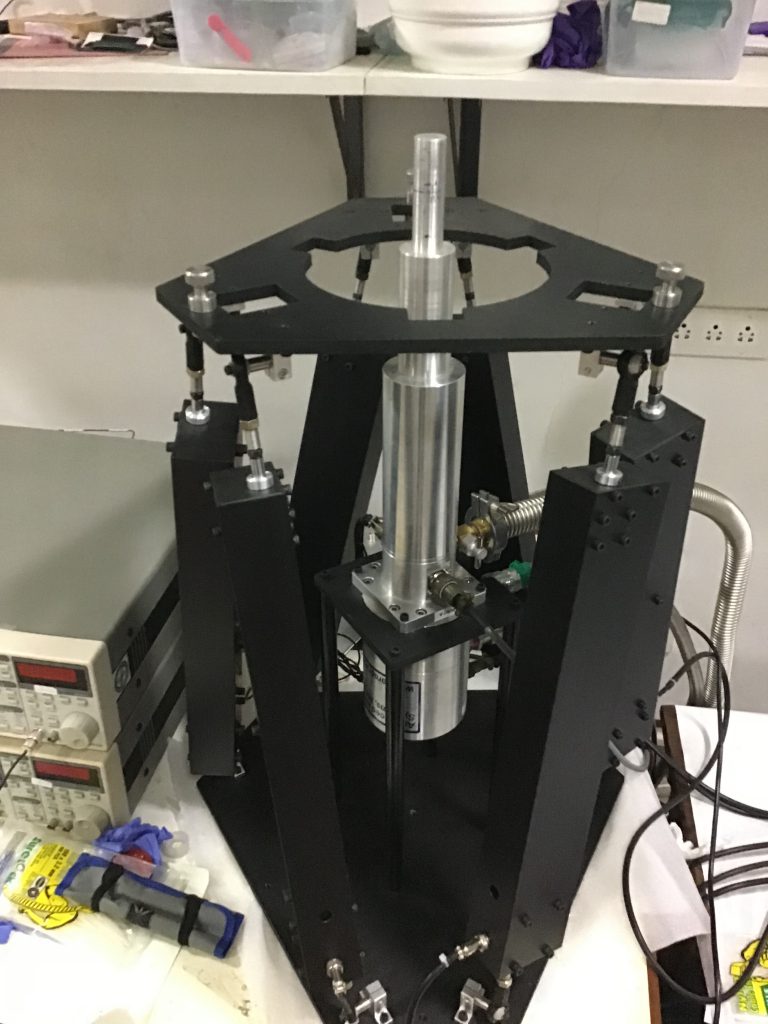
“We try to minimise reliance on commercial equipment, which significantly reduces costs. For example, the sputtering system built in-house for the cleanroom cost around Rs 1.1 crore, whereas a comparable commercial system would have been close to Rs 3 crore. Beyond cost savings, this approach gives students valuable hands-on experience, making them familiar with how these systems work. Similarly, most of the vacuum systems in the lab have been designed and fabricated in-house here in Bengaluru, often with support from local collaborators,” explains Anil.
Spin physics to smart memory
“There is a fundamental gap in today’s computing systems. Your processor operates at gigahertz speeds, meaning it responds on nanosecond timescales. But your storage devices, like SSDs, are much slower; they take microseconds to milliseconds to access data. This mismatch creates what we call a memory gap, where the processor is much faster than the memory it depends on,” explains Bhagwati Prasad, Assistant Professor in the Department of Materials Engineering, IISc.
Traditional memory devices store information by moving electrical charges through transistors and capacitors. For example, dynamic random access memory (DRAM) in our computers needs constant power to retain data, while flash memory writes information by trapping charge but is slower and wears out over time. As data moves back and forth, it consumes time and power, generating significant heat, especially in modern AI devices. Alternatively, spintronic devices store information using an electron’s spin, enabling fast, non-volatile memory, where information can be stored and accessed quickly with much lower energy.
In such devices, spins can be manipulated using a technique called spin-transfer torque (STT). Imagine two magnetic layers separated by a very thin barrier called a magnetic tunnel junction. One layer has electron spins locked in place, while the other is ‘free’ – spins can align in any direction. When current passes through the fixed layer, electrons having spin in the same direction as the fixed layer pass easily. After crossing, more electrons end up aligning in that same direction – a phenomenon called spin polarisation. When these spin-polarised electrons reach the ‘free’ layer, they push on the spins of the ‘free’ electrons and force them to flip direction. The torque in SST corresponds to the force needed to flip direction.
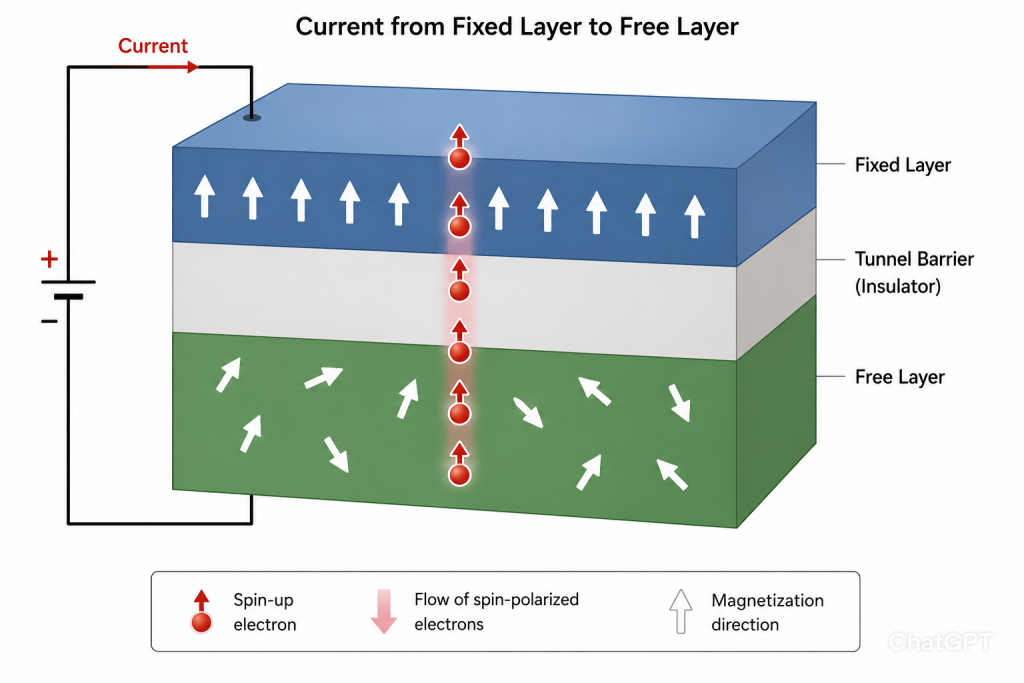
A more recent approach is spin-orbit torque (SOT), where instead of passing current directly through the magnetic layers, the current flows through an adjacent heavy metal layer (like platinum), generating spin currents that can switch magnetic states even more efficiently. This switching creates two distinct states – when both layers point in the same direction, the device has low resistance and when they point in opposite directions, the resistance is high. These two states can represent binary information as 0s and 1s. Writing data involves sending a current to switch the state, while reading it involves measuring the resistance. This is what happens in magnetoresistive random access memory (MRAM).
Unlike conventional memory, which stores information as electric charge that disappears when power is turned off, MRAM stores information in magnetic orientations, which remain stable without electricity. The spins remain in their orientation until another flow of current intentionally flips them. Switching in MRAM simply involves rapidly flipping magnetic orientations, which can happen in nanoseconds. This makes MRAM faster, more energy-efficient, and highly reliable.
Between 2006 and 2008, during his Master’s at the Indian Institute of Technology Kanpur, Bhagwati found himself captivated by the idea of spintronics. During his PhD at the University of Cambridge, he fabricated various devices starting from metal junctions (like those in MRAM) to more advanced spin filters. Spin filters allow electrons with one spin orientation to pass while blocking those with opposite orientations, enabling controlled spin-polarised currents.
When he was later at University of California, Berkeley, he contributed to the invention of many new fundamental device concepts in collaboration with teams at UC Berkeley and Intel. He then moved to the R&D center of Western Digital in San Jose, California, where he worked on the development of MRAM technologies for industry. His lab at IISc now works on discovering new materials, designing novel devices, and developing energy-efficient memory and sensing applications.
A major challenge in magnetic memory is that switching the orientation of tiny magnetic elements often requires large magnetic fields, which are typically generated using high currents and bulky coils. To overcome this limitation, Bhagwati’s group is developing approaches in which electric fields can directly control magnetic states, drastically reducing power consumption. Several projects from his group have also attracted support from industrial partners, including Micron and Lam Research, with a focus on developing low-power memory technologies across different material and device platforms. “In the next 10-15 years, we are likely to see a decade driven not by logic, but by memory, which is going to make a big difference, and we aim to be among the leading groups in the world contributing to this transformation,” he says.
It’s not just memory that spintronics can revolutionise. It could also lead to entirely new computing architectures beyond the limitations of conventional electronics. Massive data centers that currently consume enormous amounts of electricity and vast cooling infrastructure that exist just to prevent overheating, could become far more energy efficient. AI systems, which demand ever-increasing computational power, may process information faster without the steep energy costs they carry today. Edge devices, from smartphones to medical wearables, could run longer on a single charge. Even future technologies like autonomous vehicles and space systems could benefit from faster, more reliable, low-power computing.
And then maybe, one rushed morning in the future, you’ll wake up late again. Same panic. Same deadline. You tap your laptop. It’s instantly awake. No boot screen. No fan noise. No lag. Your document is already there – not “loaded,” because it was never truly “off.” Memory didn’t need to be rewritten; it simply remained. You make your edits, hit send, and are done in seconds. The laptop may look the same. But deep inside, electrons might be doing something entirely different – spinning their way towards the future of computing.
Shreya Vashista is a second year MTech in Bioengineering student at IISc, and a science writing intern at the Office of Communications
(Edited by Rohini Subrahmanyam, Ranjini Raghunath)