Creating under constraint
When Umesh Varshney joined IISc as an Assistant Professor, he was excited to dive straight into microbiology research. It was 1991, and he had just returned from his postdoctoral stint at MIT in Cambridge. He planned to study protein synthesis in Escherichia coli and DNA repair in mycobacteria, among other exciting topics.
But it wasn’t going to be an easy road. “My first grant from the Department of Science and Technology was for Rs 6 lakh, to be used over three years,” recalls Umesh, now Honorary Professor at the Department of Microbiology and Cell Biology, IISc. He had to set up his entire lab, admit PhD students, conduct research and publish papers, all with this meagre amount.
He first purchased a computer, an Intel 286 with 4 MB RAM and 40 MB storage on a hard disk. He then had to order various products and equipment, such as reagents and enzymes, from abroad, which took months to arrive and cost almost twice what they had cost when he was in the USA. “You had to keep track of prices in the USA and then negotiate with them,” he recalls.
He had to come up with better ideas that would save time and money, and produce good results.
One day, while reading the newspaper, he noticed how pen ink spread on the paper, just like it would on blotting paper. A strange idea struck him – why not actually use newspapers as blotting paper? Southern blotting – his lab’s go-to technique for identifying specific DNA sequences – consumed large quantities of the stuff.
He began thinking of similar hacks. Instead of buying enzymes, his lab began purifying enzymes from specific bacterial strains, which also proved to be of higher quality. He cut and used plastic combs of different sizes to create a varied number of wells in gels for gel electrophoresis. Instead of plasticware, he used glassware, which is reusable and recyclable, and stored them in chromic acid to sterilise them.
These were all trial and error; some worked, some didn’t. For example, the teeth of the comb were sometimes uneven, so he had to throw them away. But, at that time, these kinds of do-it-yourself (DIY) tricks were crucial.
“In retrospect, these were small ideas, but at the time, you needed those … if we wouldn’t do any of these, we would not publish, and if we would not publish, we would not advance,” says Umesh.
Resourceful improvisation is not unfamiliar to scientists. As Ernest Rutherford, a pioneering physicist known as “the father of nuclear physics”, once told his students: “We haven’t got the money, so we’ve got to think.” Rutherford believed in simplicity and hated both raising money and spending it. When he couldn’t create a vacuum-tight apparatus for his famous scattering experiment (which led to the discovery of the new atomic model at that time), he had to rely on sealing the gaps using wax, the same viscous substance used to close envelopes at that time. It was not glamorous, but it worked.
But limited funds are just one impetus. Sometimes, the world stops for a pandemic, disrupting the procurement of tools. Or there’s a delay in an order, and scientists have to build something out of what they have at their disposal. And sometimes, it is the need to have something so specialised that it is not available in the market. This was the case for Ambarish Ghosh, Professor at the Centre for Nano Science and Engineering (CeNSE), IISc.
Built to specification
Ambarish started with a simple, curious idea. He wanted to understand and design the motion of small objects in fluids. As it progressed, he and his team realised that this fundamental research had applications in multiple domains, including medicine.
His lab designed and developed nanorobots. Like Doraemon, these do not make decisions on their own, but can still show signs of intelligence. These were very small coil-shaped structures. Their motion can be controlled in all directions using a time-varying magnetic field. Ambarish wanted to test them inside living systems.
To keep cancer cells alive under a microscope for long periods, they must be maintained at a specific temperature, around 37°C. However, all commercially available setups were made of metals, which, when placed in time-varying magnetic fields, would heat up, killing the cells.
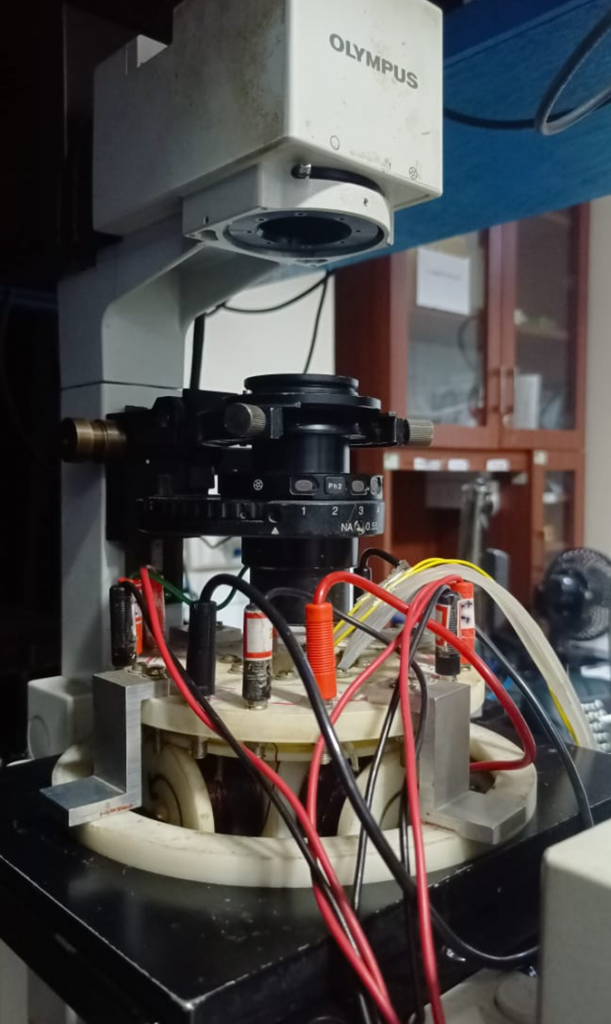
Another problem was accommodating a temperature- and pH-sensitive system within the magnetic fields, which were generated using Helmholtz coils – two parallel flat circular coils separated by a distance equal to the circle’s radius. Both carry current in the same direction, producing a uniform magnetic field at the centre. To generate magnetic fields in all directions, they had to use a triaxial Helmholtz, with three perpendicular pairs of coils.
These issues pushed them to build their own live-cell imaging system, a miniature non-metallic chamber, using derlin – a highly durable plastic; a chamber which could fit inside the uniform space of a triaxial Helmholtz.
Paramita Modak, a PhD student in Ambarish’s lab, built the first setup. Using a feedback loop, the system maintained a temperature of 37°C with a 1° tolerance. Later, wanting more precise temperature control to carry out their experiments, Benexy Correya, another student in the lab, designed a second model with a tolerance of 0.1°C by introducing slow cooling and heating with better thermal insulation.
With their new improvised setup, cells stayed alive under continuous exposure to magnetic fields for more than 36 hours. Ambarish’s lab is now tackling various fundamental and real-life problems, including dental hypersensitivity, intracellular properties, and more.
“We do this all the time in our lab. I encourage my students to make their own equipment,” says Ambarish. “The advantage is that once you build it, only you can do that now and answer questions that no one else has. The disadvantages are that it makes the research work harder and more time-consuming.”
Frugal by design
For PhD student Anil Yadav, who sits a few rooms away from Ambarish’s lab, harder work and longer times were no deterrent.
When Anil joined IISc to pursue his PhD in 2021, he wanted to test the change in electrical properties of semiconducting polymers after infiltrating them with inorganic materials using gaseous molecules. His PI, Aditya Sandhala, Assistant Professor at CeNSE, suggested that they build their own infiltration system, as none were available commercially at the time.
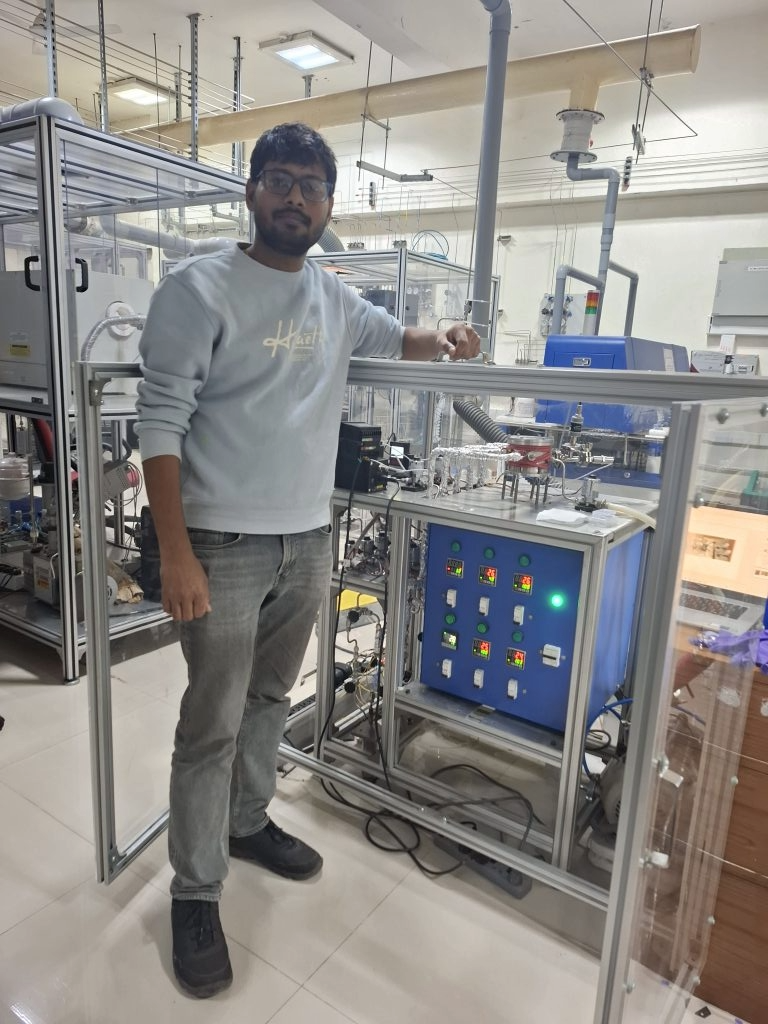
Later, given the identical deposition mechanism, the idea was expanded to build a full atomic layer deposition (ALD) tool that is capable of operating in multiple modes.
An ALD machine allows you to deposit highly uniform and fine layers of atoms over one another, even over not-so-perfect flat surfaces.
Commercial ALDs operate at high temperatures, ranging from 150-400°C and require specialised precursor substances – the raw chemicals introduced into the machine as gases that react with the surface to deposit one atomic layer at a time. These precursors are highly specific to the material being deposited and have to be purchased from outside India. “The delivery time is around six months, and the transportation cost is almost double or triple that of the precursors. It also takes around Rs 6-7 lakh just to buy one precursor … [and] the shelf life is also not that long,” says Anil.
So, Anil, in collaboration with three other researchers, started to build their own ALD in March 2022, alongside regular lab work. It was a challenging process. One of the main concerns was potential leaks – the precursors used are pyrophoric (they ignite instantly in air). “Making it completely leak-proof was a big task,” says Anil. Helium-leakage test kits were available but expensive, so Anil found other ways to test for leaks, such as using acetone, an easily available and comparatively inexpensive solvent.
After three years of trial and error, they managed to build an ALD that can operate at much lower temperatures, around 50°C, and can use solution precursors readily available in India, such as diethylzinc and trimethylaluminium in organic solvents for zinc oxide and aluminium oxide thin film depositions. It also allows one to control the precursor exposure time, enabling highly customised experiments.
After three years of trial and error, they managed to build an ALD that can operate at much lower temperatures, around 50°C
Even more remarkably, their ALD tool costs under Rs 20 lakh; commercial ALDs can easily go up to Rs 5-6 crore.
“There were many things that were still expensive. We cannot make the [vacuum] pump, and that alone costs around Rs 8-10 lakh,” shares Anil.
The ALD system now sits in Aditya’s lab. It still requires some fine-tuning to perform on par with the commercial one; nonetheless, the tool is able to perform operations at a rudimentary level. After successfully obtaining the patent for the ALD setup, Anil is now drafting a second patent for the infiltration.
A variable process
For some, making their own equipment was more straightforward. Biman Jana, an ex-PhD student in the lab of Anshu Pandey, Professor at the Solid State and Structural Chemistry Unit (SSCU), built an infrared photodiode material that could operate at room temperature. Such diodes can be used for highly sensitive gas sensing and for long-range search-and-rescue drones. Someone was needed to test the material’s efficiency and functionality. The task fell to Ankur Bhaumik, a former BS-MS graduate student.
The core problem with infrared photodetectors is thermal noise. “When you use the device, you have to cool it down to a very low temperature so that you can reduce the thermal noise,” says Ankur. The new IR photodiode sidestepped this issue. But it had to be tested first.
The COVID-19 pandemic had recently ended. The world was just going back to normal. Ankur had to work with what was available in the lab to come up with a proof-of-concept for the photodiode.
“People have done this in other labs … they often use lenses. We didn’t have lenses, so the idea was to do it with mirrors,” he explains.
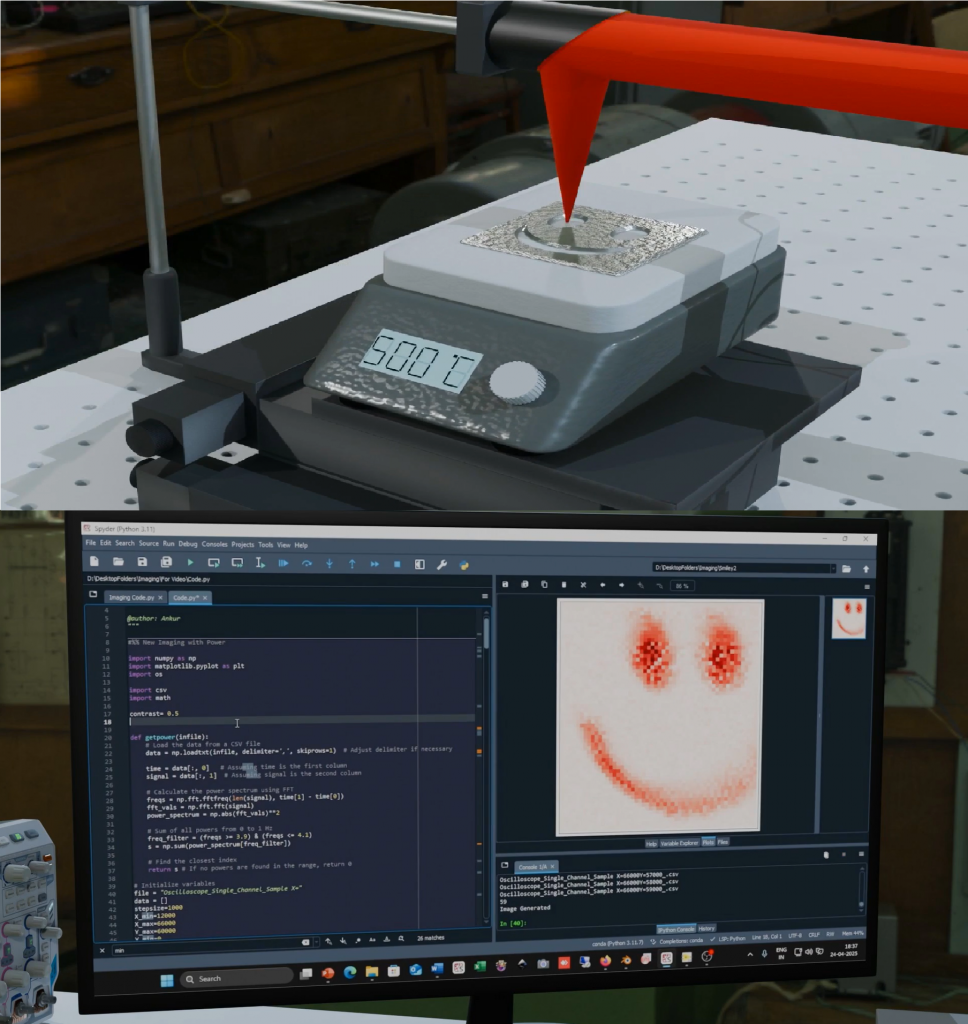
He used a heating plate capable of reaching 500°C as the source of infrared radiation (IR). He then covered the plate with different cutouts of aluminium foil to block IR at specific locations. Using two parabolic mirrors, he focused the IR onto the photodiode, which was connected to a sensor and a monitor to capture the readings. By motorising the plate, he captured one pixel at a time and later used a program he built to reconstruct the image.
He successfully reconstructed images, demonstrating the photodiode’s ability to capture IR. This provided a proof-of-concept for an IR photodiode that could operate at low temperatures.
Obtaining the necessary drivers for the motorised platform to control its precise motion and the optical alignment of the setup was tricky. “The drivers were not readily available,” says Ankur. He spent over a month in back-and-forth email exchanges with the equipment manufacturer before finally receiving the software needed to control the platform’s precise motion.
They also wanted to prove that the IR photodiode was sensitive enough to detect even weak IR signals. But weak signals are easily drowned out by noise. To clearly capture them, Ankur added an oscillating chopper, an amplifier, and noise filters to the setup. It worked.
“It was a fun thing to do,” says Ankur.
Virtual worlds
Like Ankur, Pavan Kaushik found a lot of fun in the DIY process. A few years ago, while doing his PhD at the National Centre for Biological Sciences (NCBS), he wanted to study the motion of Diptera (flies) in large environments and their responses to stimuli such as odour plumes and air flow, using a VR setup. But creating a true VR setup was not possible with the funding he had. So, he took inspiration from his lifelong hobby – video gaming. “The only thing I knew was video games. So, I built one for insects,” says Pavan.
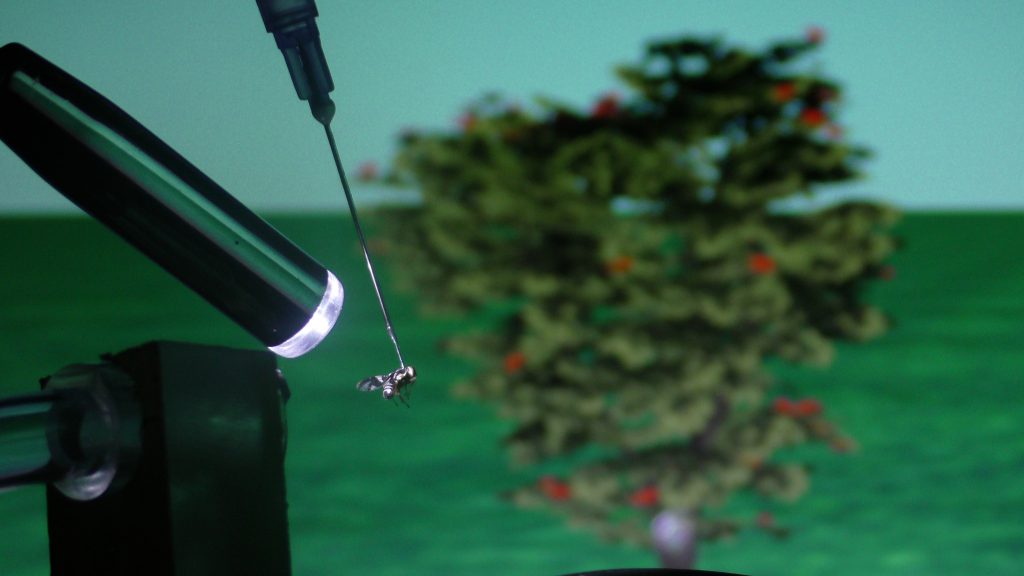
He learned coding from scratch and developed his own software. He then purchased three high-refresh-rate displays and built a cubicle to create a 360-degree virtual environment that provided visual stimuli for the flies.
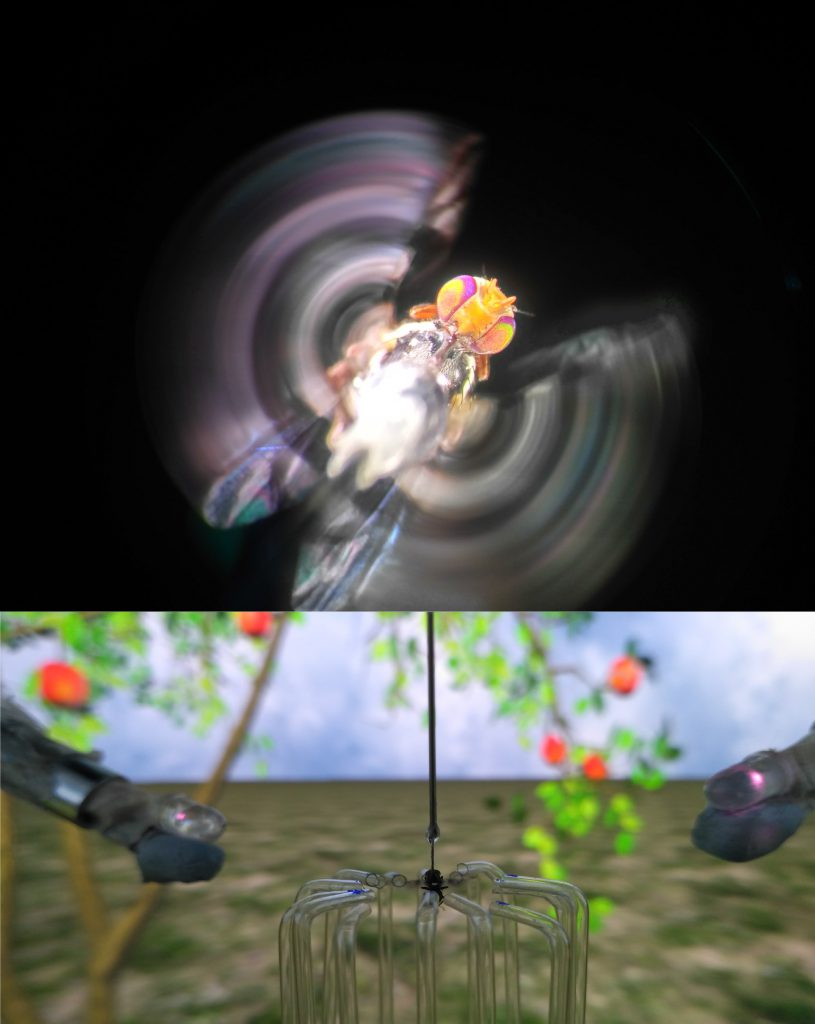
Each fly was fixed in place by glueing it on its back to a thin rod inside the cubicle, but its wings were left free to move. A camera was placed on top to capture the motion of these insects’ wings.
When the displays were turned on, showing photorealistic scenes of a vast open landscape – trees, grass, and sky rendered across a virtual world stretching over a kilometre in each direction – the flies would flap their wings in place. Based on the flapping motion, Pavan trained a model to determine whether the fly wants to turn left, right, or just fly straight.
In effect, the flies’ wings served as their joystick to navigate the virtual environment. The camera captures how hard the insect flaps its right versus its left wing. This data was fed to the model to allow the insect to control their motion. As the virtual environment around them changed, they responded by adjusting their flight direction.
In effect, the flies’ wings served as their joystick to navigate the virtual environment
Later, Pavan inserted capillaries into the setup to introduce air flow and odour. This allowed him to test various hypotheses about the flies’ navigation in response to different odours and airflow rates.
Using this setup, he was able to propose a few theories. When presented with two virtual trees – one large and far away, and one small and close by – even though both appeared the same from the flies’ starting position, the flies always chose the smaller one. This showed that the flies were using motion parallax – the phenomenon in which nearby objects appear to move faster than distant ones – to judge distance and make navigational decisions, much like humans do. Pavan also observed that the flies didn’t effectively react to the odour plume trail without a directional wind flow.
While his research focused on the apple fly, his team also successfully tested the VR system on a variety of species, including moths, lice, and mosquitoes. His paper was published in the Proceedings of the National Academy of Sciences (PNAS) in 2020.
“Making an insect play video games by giving out realistic vision, airflow, and odour still feels unreal to this day,” shares Pavan.
A culture of ‘jugaad’?
It is no surprise that India’s affinity for ‘jugaad’ has infiltrated research too. Science has always been about negotiation – between ambitious questions and modest tools. Researchers have navigated this gap for ages with clever improvisation. Now, they are going much further, building entire equipment on their own.
As Ambarish points out, modern problems are very complex. They require much more planning and precision. “I would not call it jugaad,” says Ambarish. According to him, this is quite the opposite. Jugaad is much more preliminary; for research, he says, you need expertise and the right planning.
“Very often, the natural tendency is to buy some equipment. For certain times, that works … but there are no custom-made tools, so you have to set up your own experiments,” he adds.
And that’s how research happens. You start with a small idea, make several tweaks in the process, which could lead to a mistake or – if you’re lucky – to good, optimal results. There might be situations where you don’t know if the solution to your problem will even work. Then it becomes a question of belief in your instinct and abilities, and whether you can find a way to learn and have fun through it all. “It was exhilarating building things, not knowing if it could even work,” says Pavan. “It began as an attempt to replicate an existing system; it quickly went off-road and became its own thing, unlike anything before it.”
Mihir Prakash Kapse is a second-year Bachelor of Science (Research) student at IISc
(Edited by Abinaya Kalyanasundaram)