The case of the missing radioactive stones
As the last flowers cling to their trees, and the spring blossoms begin to fade on campus, the onset of summer is marked by a very special time at IISc: the arrival of Open Day.
Gates open, labs light up, and thousands of people throng the campus, marvelling at seemingly seamless demonstrations and cutting-edge science. To a visitor, everything appears to work.
The night before D-day, however, just hours before the gates open, things are not so smooth. Some demonstrations, in fact, have utterly failed. And no guarantee that they will work even by morning.

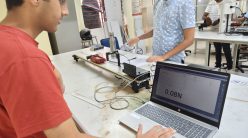
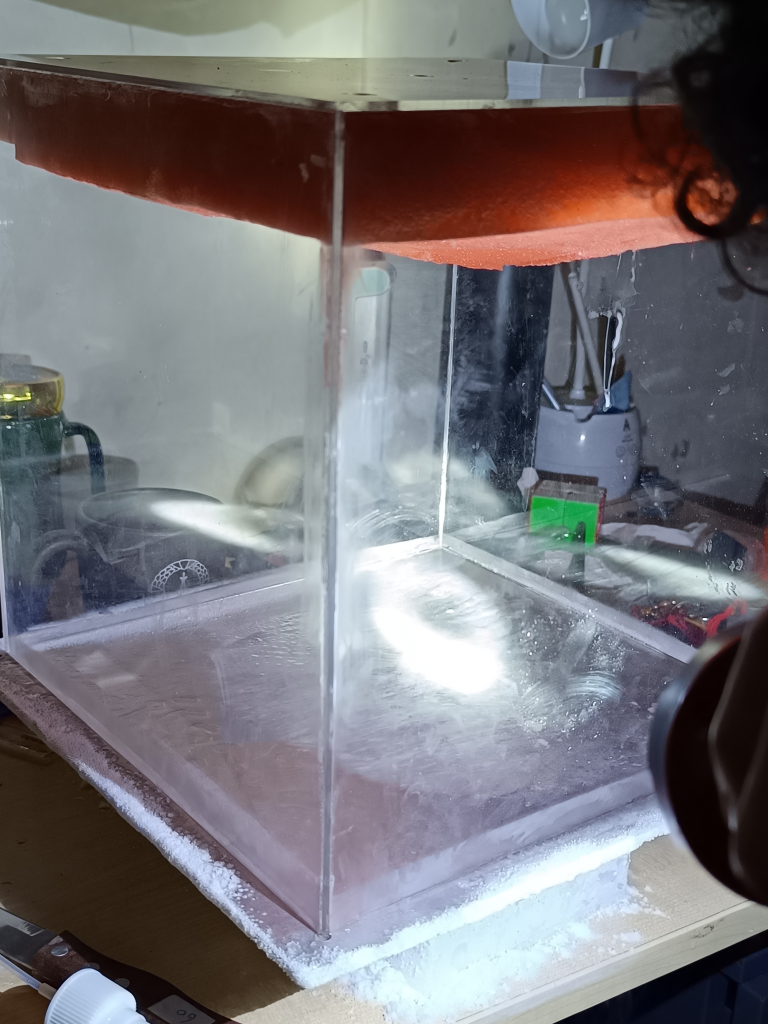
On the undergraduate side of campus, four first year physics enthusiasts – Ryan Ray, Govind Agarwal, Savio Joseph, and Dishaanth Basu – were trying something that even the Physics department, due to their previous track record, had given up on: the cloud chamber, a neat way of making invisible particles visible. Neat, of course, only if it worked.
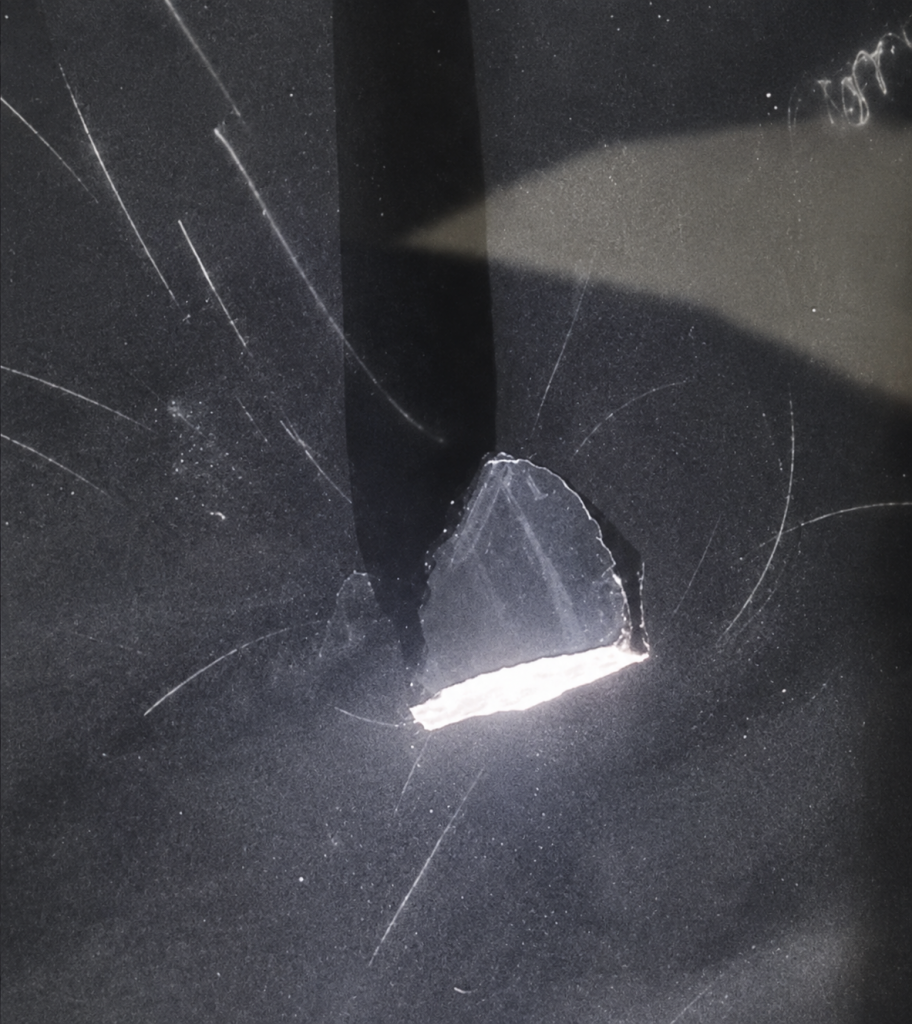
A cloud chamber is a particle detector that helps visualise invisible paths of subatomic particles. It creates an environment of supersaturated vapour of alcohol – meaning that the vapour is very close to condensing into liquid – which interacts with energetic particles, thus ionising the vapour. The alcohol vapour rapidly condenses around these particles, leaving a cloudy, visible trail of particles.
“Now, the issue with this is that it is a very simple setup, but to actually see these particles, we need radioactive rocks that are very rare and a little hard to find,” says Ryan. And so, they thought they’d get hold of some radioactive material.
How difficult could it be?
They started by asking one of their professors for help, and got referred to Sanjay*, who agreed to lend them three pieces of zircon – crystals with trace quantities of uranium in them. Those polished gemstones of zircon were extremely valuable, but the students promised the professor that they would take good care of them.
At first, Ensemble, the UG Physics club, was a bit sceptical about whether this experiment should be done or not. In fact, they didn’t even add it to the official experiments list, because the same experiment had been done at a lot of places, and it just didn’t work well at all. “But we were adamant,” says Govind.
Their stubbornness didn’t help. The zircons weren’t radioactive enough to show significant trails of the particles. In fact, even the contingency plan that they had thought of for this exact scenario – a different radioactive source that they had bought from Amazon – also failed. More than failed, they got scammed because the source did not contain any radioactive material, despite what they were led to believe. And the product was not refundable.
Open Day was just four days away now, and so far nothing had worked. Thankfully, Sanjay had mentioned another, even more precious radioactive source – a monazite sample – that he could lend, in case the zircons didn’t work. The students emailed him asking for the monazite sample, to which the professor agreed, and asked them to return the zircons.
At the time that they received a reply from the professor, Ryan and Savio were out of campus buying a few remaining items for the setup. The box of zircon samples had been left in Ryan’s room.
When Govind entered the room, the box was gone.
He searched the table, looked into the drawers, under the bed, and … nothing. Panicking, Govind asked Ryan’s roommate if he had any idea. The roommate didn’t, but mentioned that monkeys had entered the room a while ago.
Ryan heard all of this on a call, and started freaking out. He sat on a pavement there, head in his hands, contemplating. Savio tried to comfort Ryan, saying, “Bro, what does a monkey want to do with zircons? Like, it’s not a banana or something.”
At this point, the only lead left was the terrace, which Ryan’s room opened onto directly. They rushed back and searched the area. Just outside the window, they found the box, with one zircon sitting inside. Another lay nearby.
The last one was missing.
While this was happening, the professor was waiting for the students to return the samples and collect the monazite. Yet, they continued searching for hours, looking under and above every leaf on the terrace – unfortunately, those leaves were the same colour as the sample – to no avail. A gem-grade zircon was gone.
The students were completely dejected. “For us, our complete reputation in the Institute [was] at stake, because we asked our professor to reach out to a different professor for something that he possesses,” recalls Ryan. “We take it from him with the guarantee that we will keep it safe. And what will we now tell him? Even if we just tell him the truth, it’s the equivalent of saying a dog ate my homework!”
All of this had gone down just two days before Open Day, and there was barely any progress made. Their only hope now was the even more precious monazite sample, but to get it from the professor, they would have to first return the zircons. And they were terrified to do that.
Somehow, the team mustered up the courage to finally go and meet the professor. They handed the box to him, waiting for the eventual scolding. But the professor seemed to have not noticed the missing zircon; he simply took the box and handed them the monazite sample. The students, unwilling to lie to him, stopped him, and narrated the entire incident nervously.
Sanjay was quiet for a moment, taking in the sheer absurdity of the situation. To their surprise, he remarked that he’d done much worse in his undergrad days. He went on to say that they needn’t have worried so much and tried so hard to retrieve the zircons, because if he lost it this way, he would have just let it go.
The students were stunned, but also incredibly relieved. In fact, Sanjay still offered the monazite sample, although with a very important caveat: if they lost the monazite too, they would be done for. The students, despite not having any other leads, declined. They didn’t think it would be appropriate to ask again, not after what had just happened.
The professor just shrugged it off, and finally said that if they were unable to get any other leads, they could come over to his office anytime the next day – a day before Open Day – to collect the sample, and he would be there.
The students knew, even as they walked away, that they would have to go back and ask again anyway. At the moment, however, they were simply trying to be good samaritans.
In the hours that followed, they scrambled to find an alternate radioactive source. They scoured the internet, made calls to any remotely related vendors, and asked everyone they could for help.
Finally, in their desperation, they stumbled across an IndiaMart listing that seemed to be selling thorium oxide – a stable, radioactive powder. Govind called the number that was being displayed on the listing, and asked what concentrations they sold. The seller rebutted him, instead asking Govind the concentration that he wanted, promising that he would acquire it.
Now, here’s the deal: a legal business selling thorium oxide cannot just provide any concentration, since the product is highly regulated by national agencies. This already set off Govind’s alarms.
But the seller wasn’t exactly trying to hide anything. In fact, he’d occasionally say something like “aap samajh rahe hai na? *wink wink*” on call, constantly trying to hint that his business was not on the most legal grounds. He also refused to share any other details, like a rough idea of the cost, or anything else.
And so, by the evening before Open Day, the monazite was their only remaining option. Because dealing with an illegal business – and possibly facing a police case – wasn’t exactly on the students’ first-year-in-college bingo card.
At 4 pm on the day before Open Day, the students trudged back to Sanjay’s office, only to find that he was not there. 5 pm came, but Sanjay still didn’t. Then 6 pm, 7 pm, then 8 pm, he still wasn’t there. The night before Open Day, they had no sample. They were supposed to have a mock run-through of the experiment with Ensemble that night, but the group didn’t even have all the required equipment.
After dinner, they decided to try one last time at around 8.50 pm. As Ryan walked up the stairs to his office, he saw something the students hadn’t seen on any of their previous attempts: the lights in his office were switched on. Eager, he ran up the stairs, and found Sanjay with two other colleagues. He told him that they needed the monazite desperately for tomorrow, and that if he gave it to them, they would protect it with their lives.
Sanjay agreed.
The students rushed back to the lab at around 9 pm, and put the sample into the chamber. They stared at the chamber, their hearts thumping loudly. It took a few minutes, but they suddenly saw wonderful trails of particles everywhere. They had somehow managed to make the experiment work at the eleventh hour.
By the next morning, on Open Day, the cloud chamber held up. Crowds gathered, asked questions, marvelled at it, and moved on to the next demonstration, without realising just how close the experiment was to not being there at all.
In the middle of the day, when it was his turn to demonstrate the experiment, Dishaanth suddenly realised that the monazite had disappeared. He decided to keep this information to himself, lest his teammates panicked.
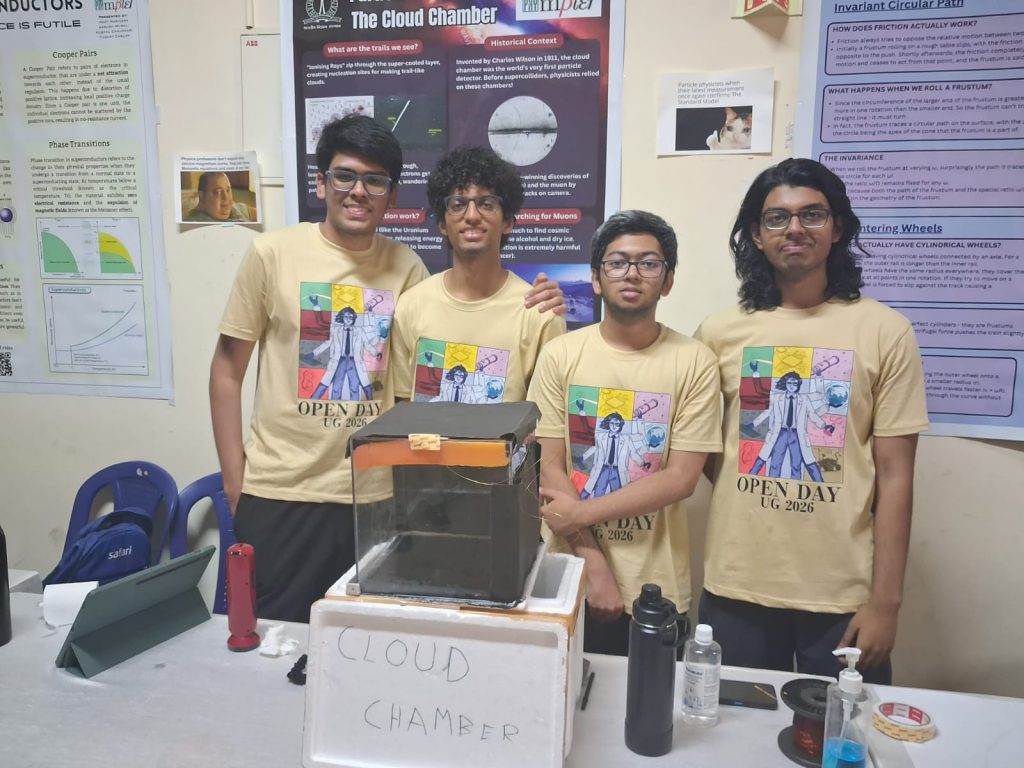
Fifteen minutes later, Dishaanth found the monazite again. Apparently, during a demonstration, a foam layer that held the alcohol had dropped onto the monazite, which had somehow submerged itself into the sponge. But that had been enough to give Dishaanth a heart attack.
Later in the day, after the stalls had all wrapped up, Govind made his way to the department to return the monazite sample. Sanjay seemed quite happy to receive the monazite back, and also asked Govind if he could show some footage of the cloud chamber with the trails. He watched with interest, and asked if he could keep a copy of the footage to show it to his students and colleagues.
When Govind was about to leave, Sanjay casually mentioned that at the end of the day, these rocks didn’t hold much value to him. At some point, he would retire, and the rocks would just remain rocks. They would serve no purpose to him.
Govind simply nodded. To think he and the team had almost lost their sanity trying to return the zircons and the monazite safely.
Speaking of which, the third zircon still remains missing. In all likelihood, IISc now harbours the most radioactive primate in Bengaluru.
Devansh Jhawar is a second year Bachelor of Science (Research) student at IISc, and a former science writing intern at the Office of Communications
(Edited by Ranjini Raghunath)