Picture a typical morning at the Indian Institute of Science in the early 1980s. Three attenders set out on bicycles, each assigned to a different part of the sprawling campus. Their task is to collect the day’s mail. They stop at departments and offices along their route, gathering letters, handwritten notes, official messages, and bills that need to be sent across the Institute.
This was the time before electronic communication had entered everyday life in India. Emails and mobile phones were still years away; messages moved physically, carried from one place to another by people and paper. By noon, after covering their respective routes, the three cyclists reach a common meeting point. During lunch hour, they sit together, sorting and exchanging the bundles of mail.
After lunch, they set off on their bicycles once again and retrace their paths across the campus. This time, their bags are filled with letters to be delivered. One by one, envelopes reach their destinations – offices, laboratories and faculty rooms – carrying news, instructions, and everyday exchanges from one corner of the Institute to another.
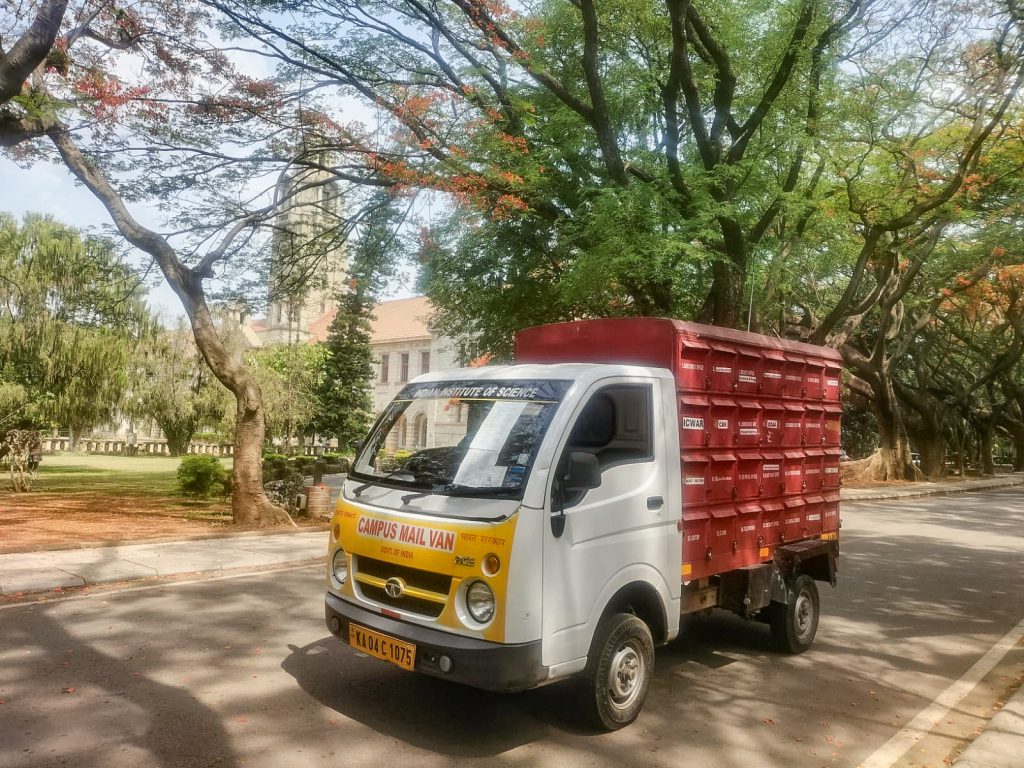
These bicycle rounds were the predecessors of the present-day campus mail van, which continues to perform the same essential duty at the Institute.
The campus mail van is a customised Tata Ace especially designed to carry internal mail across the institute. The vehicle has been modified to accommodate 85 metal mailboxes, each clearly labelled with the name of a department or office. These boxes function as individual collection points for campus mail. Each mailbox remains locked, and the keys are kept with the respective departments. Staff members open their department’s box to collect the mail addressed to them. When documents need to be sent to another part of the campus, such as letters, posters, bills, or official papers, they are posted through the mail slot of the box labelled for the relevant department or office. As the van makes its rounds across the campus, it collects these items and delivers them to their destinations.
The campus mail van makes two rounds of the Institute every day, following the same route each time
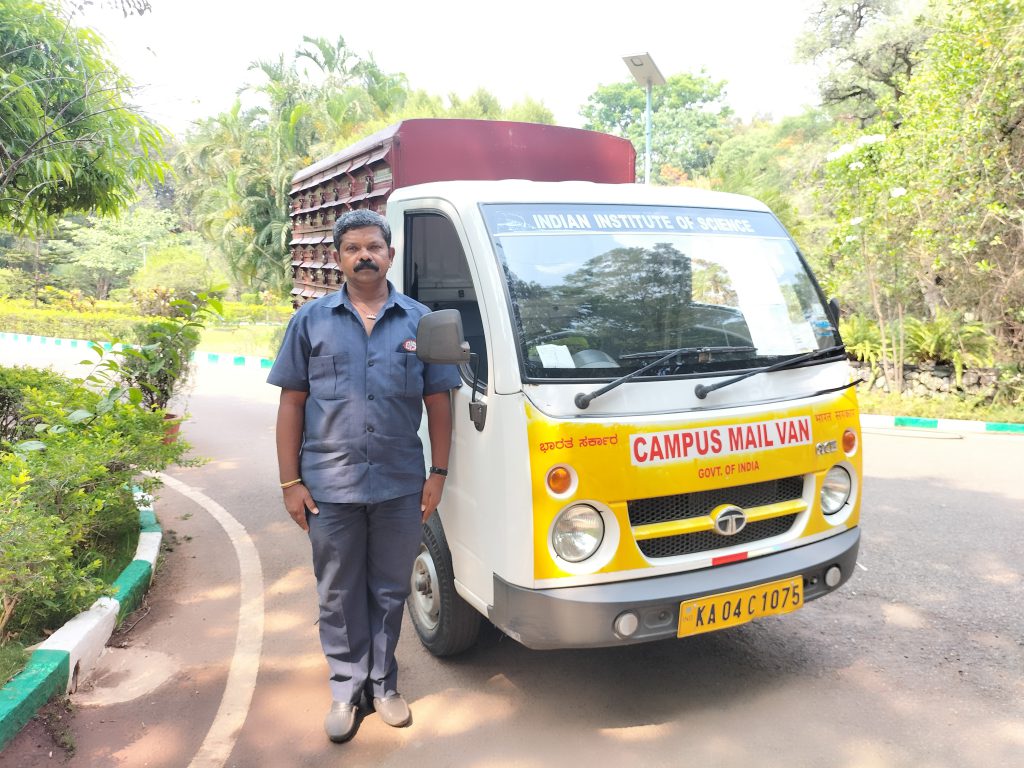
The campus mail van makes two rounds of the Institute every day, following the same route each time. Each round covers about 22 kilometres. V Thimmaiah, who has been driving the van for several years, explains that both the route and timing are fixed. “Every day, the van begins its first round at 9.30 am from the Contract Management Cell on Amra Marg and follows a set route across the campus,” he says.
The van travels a long circuit throug all the campus lanes, covering the departments, offices, and guest houses. A minimum of 50-60 pieces of correspondence are delivered across the campus every day.
At lunchtime, the van halts at the Central Stores for about an hour. It then begins the second round of the day at 2 pm, covering the same route once again. The double trip ensures that if someone wants to send a response to the mail they received in the morning, they do not have to wait until the next day. At night, the van is parked under the portico at the Challakere Campus office.
The campus mail van is maintained by the Contract Management Cell, formerly known as Unit 3. Vasanthan AA, the Assistant Registrar who heads the cell, says this is a unique facility at IISc and that hardly any other institute has such a long-standing, continuously operating internal mail system. He believes the mail van has become an integral part of IISc’s system and culture.
“We maintain an Excel sheet and record the number of documents posted every day,” he explains. “Every month, we conduct an audit to review how many mails were transported. To date, not even a single mail has been lost. It is the most trusted mode of communication on campus.” Vasanthan points out that the van drivers have been instructed not to exceed the campus speed limit of 20 km per hour. “If someone misses the van and still wants to post a letter, they often get another chance,” he says. “Because the van moves slowly, people can easily catch up and drop their mail.”
The internal mail delivery system was started during the tenure of Deputy Registrar Captain Venkatesh in the early 1980s. Ravi R, former Office Supervisor of Unit 3, was associated with the mail service since its inception. He recalls that in the early 1980s, the Institute realised that having each department send its own staff to deliver mail across the campus was a waste of time and resources. To address this, a centralised delivery system was introduced. The three cycling attenders arrangement worked well for some time. However, as the Institute expanded and the number of departments and centres increased, delivering mail by bicycle became impractical.
The Institute then introduced a three-wheeler auto rickshaw for the purpose. A few years later, as the campus continued to grow, this, too, proved inadequate. The next solution was a Bajaj vehicle with a trailer attached, which was used for several years. But this vehicle had its limitations as well. “After the Institute’s underpass was built, the vehicle did not have enough power to climb through it,” Ravi recalls. Finally, the present vehicle was deployed in 2011, and it has been running smoothly ever since. “The vehicles kept changing, but the process of mail delivery continued uninterrupted,” he says.
Moving at an unhurried pace, the campus mail van chugs through the lanes of the Institute. Inside the rows of metal boxes are all kinds of documents – official letters, circulars, bills, notices, newsletters, posters, greeting cards and magazines that keep the Institute vibrant. Rani Amma, the Office Attender at the Centre for Society and Policy (CSP), has been collecting the centre’s mail for many years. She waits for the mail van to arrive at the CSP gate at 12.30 pm. Rani recollects that the mail van has been arriving at the same time for several years.
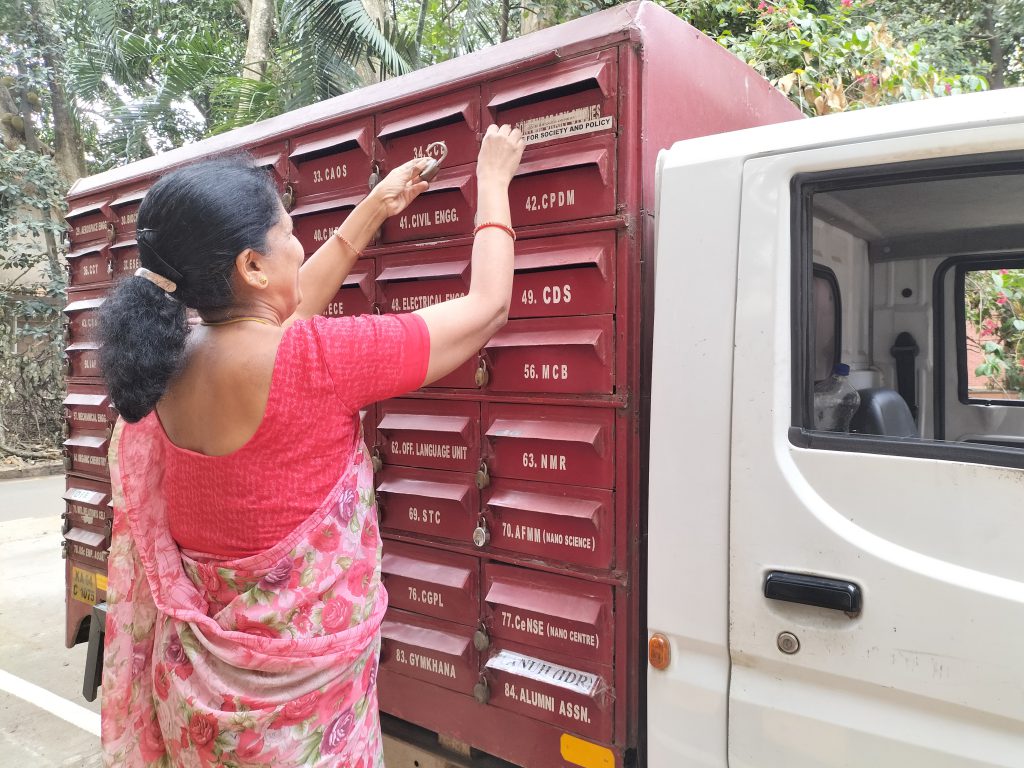
“It is a useful service of the Institute, since I do not own a vehicle, I would have to walk a lot to deliver the documents, if the mail van were not there. On some days, when I am busy with other tasks, I simply call the driver and say, ‘Anna, please wait a little longer,’ or they ask me to come to the nearest stop to collect the mail. They are very understanding,” she adds.
Thimmaiah is the oldest of the seven drivers who drive the van on a rotation basis. He has been cleaning the van every morning before the trip starts for the past 15 years. Though a monotonous routine, he considers it “god’s work”. “On rainy days, we stop under a shed since there is a danger of the documents getting damaged; we do not take the chance,” he says.
‘Many new departments come to me with requests that I add their mailboxes to the van. It is a sign of prestige to have a dedicated box in the iconic mail van’
Despite the faster, digital modes of communication available today, the campus mail van continues to remain popular on campus. “Many new departments come to me with requests that I add their mailboxes to the van. It is a sign of prestige to have a dedicated box in the iconic mail van. In this age of digital communication, a physical copy has become even more personalised and special,” Vasanthan explains.
For almost five decades, the mail delivery system has been woven into the rhythms of campus life. The van stands as an enduring symbol of IISc’s living history. In an age defined by instant messages, emails and rapid exchanges of information, the quiet journey of the campus mail van across the leafy avenues of the IISc campus offers a gentle contrast. Its slow and steady movement reminds us that communication does not always have to be instantaneous to be effective.
(Edited by Sandeep Menon)