How informal settings unlock new ways of thinking
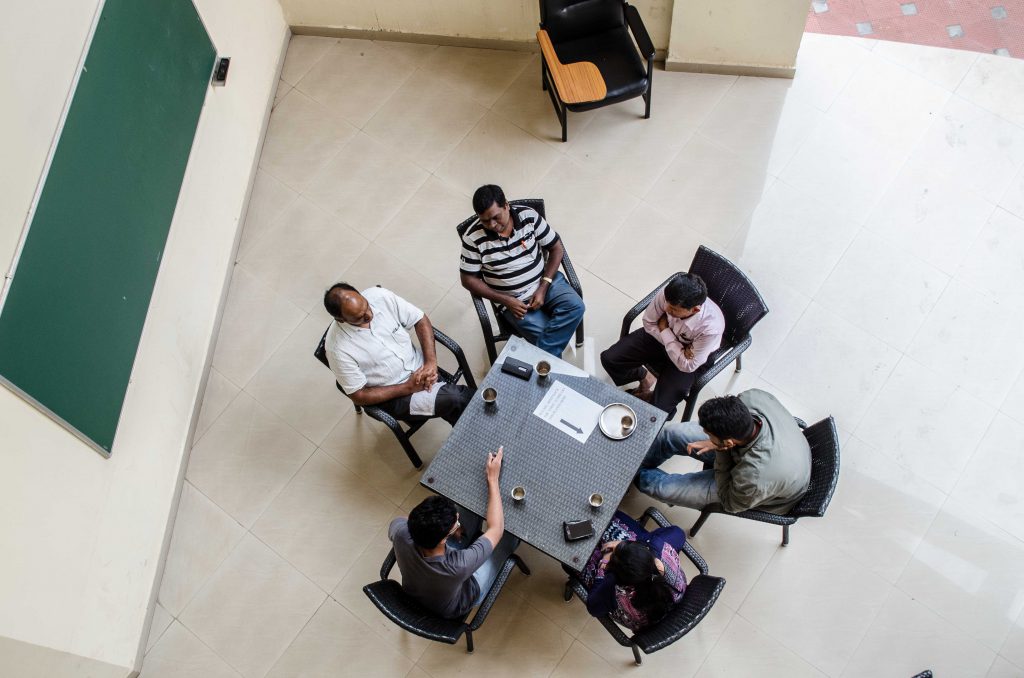
When he started working at IISc many years ago, Rishikesh Narayanan used to pull people from his lab to get coffee at Prakruthi, an outdoor campus cafeteria that closed down in 2020. “I am a coffee addict,” says Rishikesh, now Professor at the Molecular Biophysics Unit (MBU).
But it wasn’t just about the coffee. Between sips, their conversations traversed many topics, ranging from Star Wars and Kung Fu Panda to dinosaurs and physics. Inadvertently, these informal chats would meander towards interesting scientific ideas. “There are several instances where the fundamental ideas that came to define the PhD projects of several students came up at Prakruthi,” Rishikesh says.
Many scientific discussions are structured and planned, held at labs, faculty offices, classrooms, or conference venues. But informal spaces – like canteens, common rooms, or sports grounds – can foster just as many scientific conversations. In fact, some campuses have deliberately designed such spaces by placing blackboards, benches with tables, and comfortable seating in common areas, where researchers can mingle outside of their labs.
‘The advantage of these informal discussion spaces is that it’s very ‘no strings attached’’
Sometimes, these spontaneous chats lead to serendipitous publications or even a successful long-term collaboration. But even if nothing substantial comes out of such unstructured discussions, many scientists believe that they are essential to keep the spark of scientific curiosity alive. “The advantage of these informal discussion spaces is that it’s very ‘no strings attached,’” says Purvi Gupta, Associate Professor in the Department of Mathematics, IISc. “Something tangible can come out of it, or it’s just a nice conversation that is enriching in other ways – you can just enjoy the conversation.”
Spaces for spontaneity
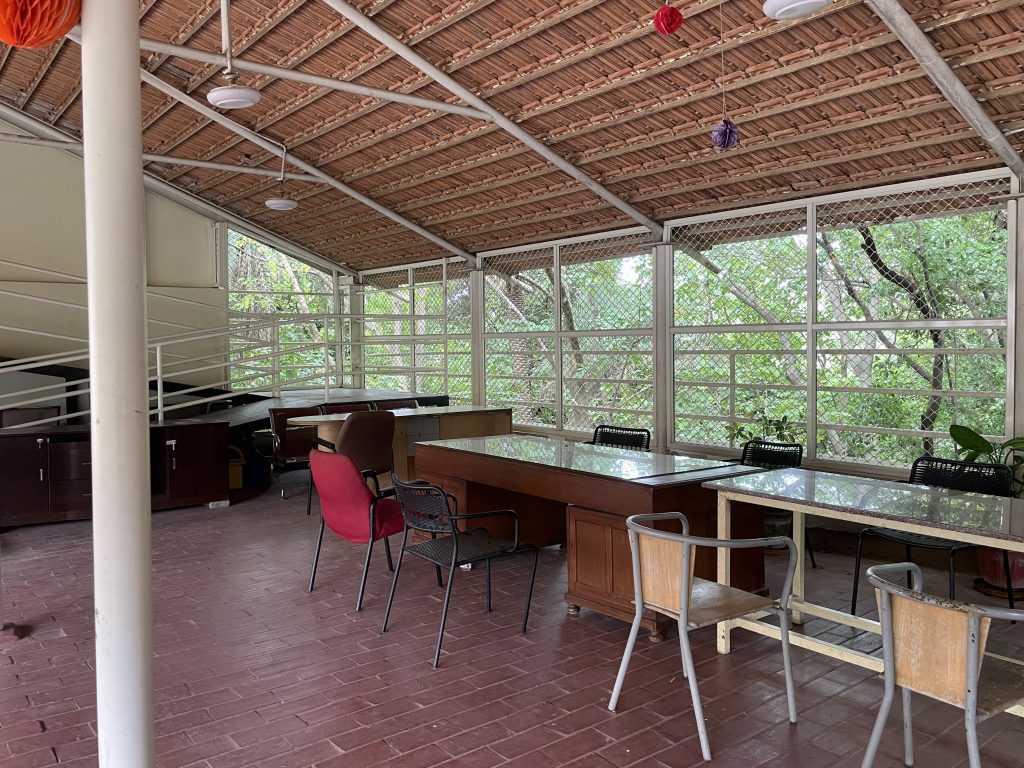
If you walk through the Department of Mathematics at IISc, you will see many blackboards at the ends of corridors, on the terrace, and even in some small cut-away spaces with tables and chairs. When Purvi was a student at IISc more than a decade ago, these blackboards were fully out in the open, but monkeys would often disrupt the mathematicians trying to use them. Eventually, the department installed glass windows around the areas and grills in one of the terraces. “Even faculty members who have their own office spaces sometimes choose to have discussions with their students or with other collaborators in these spaces because they are a little bit more open,” says Purvi. “You can enjoy the greenery.”
Another plus point of these spaces is that they help researchers leave behind the clutter of their office desk and other pending work and focus entirely on the discussion, Purvi says. She has noticed students from other departments use the little nooks as well.
These little spaces were first conceived by Gadadhar Misra, former Chair of the department and presently Visiting Professor at IIT Gandhinagar. The push arose from a practical need – before the rooms were completed in 2011-12, there was not enough space in the department for people to meet, as the lecture halls would always fill up.
‘The fact that you can walk up and down brings a kind of feeling of freedom, that you can let your thoughts not be restrained’
Gadadhar particularly likes the open terrace with the blackboard right at the top of the maths building. An office can make one feel more claustrophobic, he says, especially for intense mathematical discussions. “The fact that you can walk up and down brings a kind of feeling of freedom that you can let your thoughts not be restrained in any way,” he explains. “That openness basically allows you to feel free.” He likens it to how people writing poetry sometimes prefer sitting out in open, scenic spaces to observe nature as they write.
Some mathematicians like to convene at cafeterias over a cup of coffee, which then evolves into a much longer conversation. Gadadhar remembers this being very common in the USA from his PhD days. “There are many movie scenes where you take a napkin in a cafe and start scribbling on the back of a napkin,” he says. “And that often becomes an intense sort of discussion leading to very meaningful results that ordinarily you wouldn’t have anticipated. You wouldn’t have walked into that coffee place thinking that that’s what you would be doing.”
Purvi also recalls seeing some colleagues working from the campus cafeteria the entire day, wherever such spaces exist on the IISc campus and elsewhere. “It’s very strange that despite all the comforts in your office, it’s sometimes actually nice to just go sit on a plastic chair and table near a cafeteria – somehow that is more conducive [for work],” she says. “As soon as you have some amount of seating, people flock to it, even if the food is terrible – it shows you how much need there is for such spaces.”
‘There is a subtle way in which I think architecture influences your thinking if you’re in a closed room as opposed to a place with a lot of light’
“I think a lot of scientific creativity and scientific activity often happens in an unstructured mode,” says Rajesh Gopakumar, Director of the International Centre for Theoretical Sciences (ICTS-TIFR), Bengaluru. “The new things, at least the beginning of a new thing, often happen through a conversation over a coffee or lunch or something. And the spaces need to give that ability to have more of these serendipitous conversations or interactions.”
The idea of keeping open discussion spaces was a major driving force in the initial design and layout of ICTS. “There’s a sense that you can think big thoughts, so to say,” Rajesh says. “There is a subtle way in which I think architecture influences your thinking if you’re in a closed room as opposed to a place with a lot of light.” The pleasant Bengaluru weather also makes it easy to have discussions out in the open.
There are many spots for faculty members and students to bump into each other for conversations at ICTS – be it an open space with tables and chairs, a small cafe/snacks counter called the Bhaskara square, the main cafeteria, or the various blackboards nestled in various nooks across the campus.
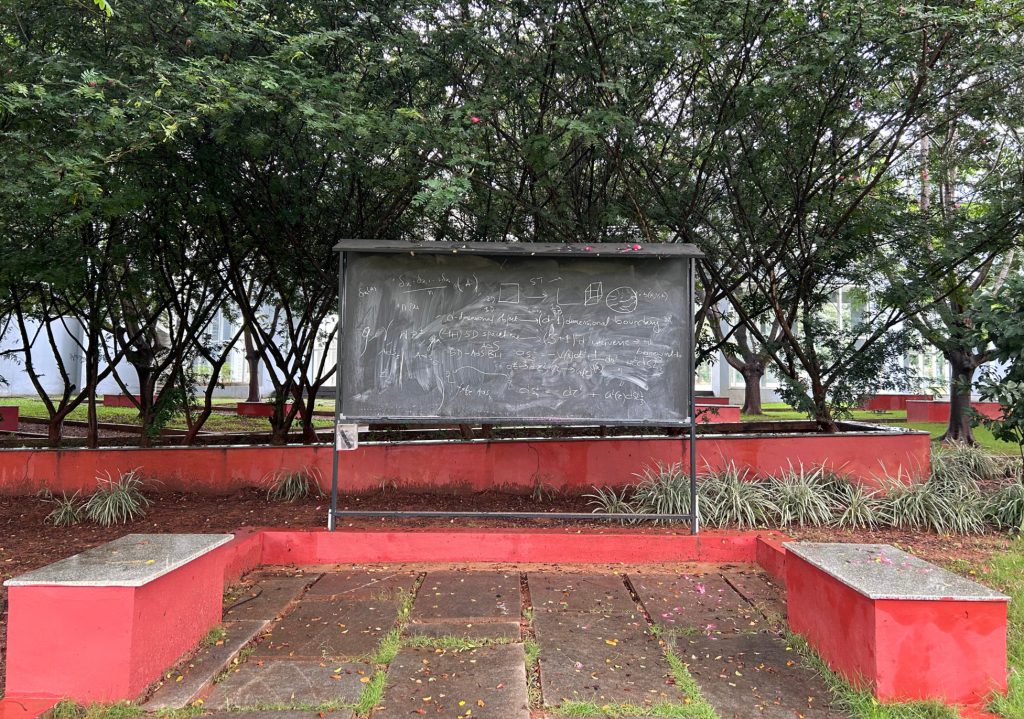
Some of these boards have various squiggly equations scribbled over them, some have chairs nearby for scientists to rest their feet even as they continue to wave their chalks about, discussing animatedly. And, as Rajesh says, they are all strategically placed in various open locations for one main purpose – encouraging the spontaneous expression of ideas. “[In] a lot of the maths, physics, theoretical areas, the thinking is often very much mediated by the blackboards,” says Rajesh. “So, that’s why they are spread all over in our institute, even in the cafeteria.” He likes the informal, ephemeral nature of the boards – how one can just wipe them clean and start afresh.
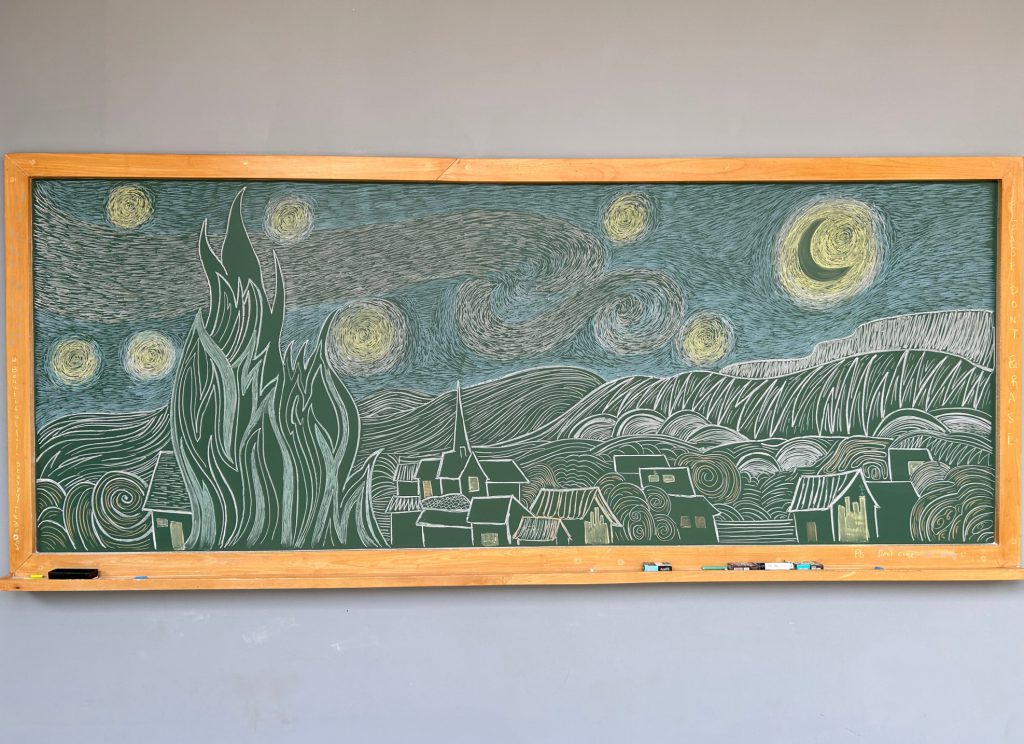
Sometimes the blackboards turn into art displays. A former ICTS student, Manish Jain, had used the boards as canvases for whimsical drawings, particularly a chalky version of Van Gogh’s Starry Night. “I like it when it’s used as a collective space, as a medium of self-expression in some ways,” Rajesh says. “It’s not only that you’re expressing your research ideas and thoughts, but you share a joke, or you share some funny statement there. It gives a kind of feeling that this is a home for creative people.”
The importance of informality
Outside spaces may physically feel more liberating and thus encourage casual, scientific conversations. But no matter where one has them, the informal, open-ended nature of these conversations in itself offers a sense of freedom. “You don’t have constraints,” says Suryanarayanan (Suri) Vaikuntanathan, Professor at the University of Chicago. “You can do what you want to do when you want to do [it].”
While at a conference at the Kavli Institute of Theoretical Physics (KITP) in Santa Barbara, California in June 2026, Suri and a colleague chatted about work over a run. Eventually, they took their conversation to a blackboard found on campus. This completely unstructured talk helped them iron out a problem that they were both stuck on, and Suri thinks that not having a specific agenda might help in finding new ideas. “You’re not coming in and saying, ‘I have a question that I want to answer,’” he says. “But you talk about what you have done, you let it seep, and then it nucleates something.”
Such informal conversations help scientists get to know their colleagues or visitors better. KITP hosts many scientists at its multi-week conferences, which typically have only one or two scheduled talks per day. The rest of the day is deliberately left free for the scientists to mingle and chat.
Martina Dal Bello, Assistant Professor at Yale University who was involved in organising the KITP conference this year in May-June 2026, shares that even the residences where the visiting scientists stay have large common rooms with comfortable couches and open spaces with multiple blackboards. And as soon as dusk sets in, the barbecue grills in the residence grounds would immediately light up, serving as a casual space for the scientists to relax, unwind, and discuss science.
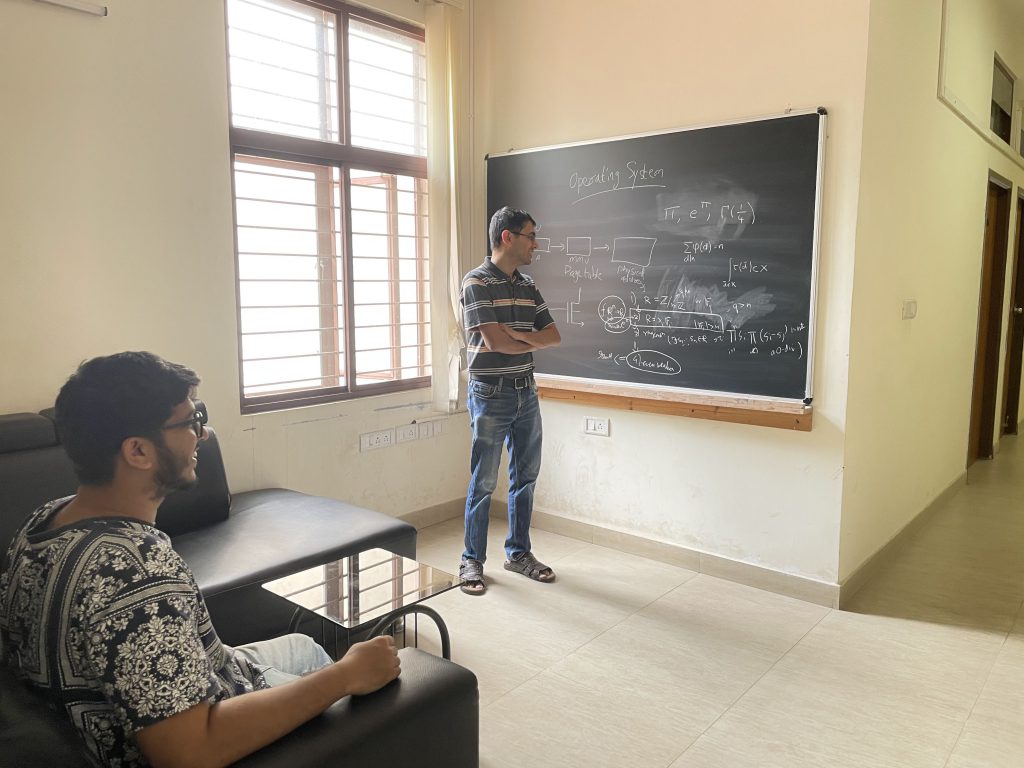
Rishikesh believes that casual conversations should also be encouraged amongst members of the same lab, as it can help build camaraderie. “Seniors help juniors and juniors have newer ideas, which are not confined by coursework,” he says. But for this, he adds, it is extremely important that supervisors not make themselves the centre of every informal conversation amongst the lab members. “It’s important to have these subgroups, individuals talking to each other,” he says.
Spontaneous discussions “serve the purpose of creating a sort of connective tissue among group members, so that they feel like, ‘okay, we can be in an informal space and still talk about science’, and maybe it’s less stressful than, ‘oh, we have to meet to discuss that with a laptop,’” Martina says.
Informal, open-ended chats can also help supervisors better understand the students’ deeper motivations and discuss any other issues that they are facing. In addition to creating a healthier work environment, such impromptu conversations can help students ideate and better define their projects.
Doing a PhD requires research, publishing papers, and graduating, says Rishikesh. But it is also an inward journey for students. “You are learning who you are, what you want, what motivates and interests you. [The PhD] just comes to define that stuff,” he says. “And such informal discussions allow you to have insights about yourself, dive deeper into who you are and what you want to do.”
Casual conversations
Whether or not there are dedicated campus spaces for scientists to hang out, researchers still find ways to talk to their colleagues or students in a casual setting. Martina, for example, likes to corral her entire group towards lunch together. “At a certain point in the day, everyone has to eat. My intent is to try to have at least this space during lunch where people can actually gather, and it’s less formal than a group meeting,” she says.
Similarly, Rishikesh also likes taking his lab for coffee or whenever there is a reason to celebrate – like someone finishing their comprehensive exam successfully, or a paper getting accepted – they take a walk towards New BEL Road for a meal, which gives plenty of opportunity for the students to chat amongst themselves as well.
Even walking back towards home from the lab can provide space for a casual work-related chat, something Rishikesh recalls doing with one of his former graduate students, Pavithraa. As they paused to part ways near the Main Building, they chatted for many hours about a particularly sticky point in her project and ultimately made a breakthrough.
‘Having such a nice environment with trees, [the] library was right across, there were perhaps some coffee places that one could go to. It was very nice’
Purvi also makes it a point to visit the Faculty Club at IISc for lunch to meet and chat with colleagues outside of her field and recalls explaining her work to them over games of table tennis. “Often when you play with your colleagues, one of the first questions is ‘what do you work on?’ But talking to somebody across departments forces you to think about how to express your research to somebody in a different area. You try to connect it to what they do,” she says. “If I’m not meeting with them to play something, that conversation may never happen.”
There is no doubt that researchers across the IISc campus, including Rishikesh, would love to gather in a Prakruthi-like space on campus again. Even outside of its cafeterias, IISc has historically – sometimes unofficially – offered many informal spaces for scientific chats. Gadadhar fondly recalls sneaking onto campus back between 1995 and 1998, when he used to work at the Indian Statistical Institute, Bengaluru, to meet his physicist friend Cherian Varughese who was establishing his own startup at the time. They would sit and chat on some stone benches nestled in a formerly green area behind what is now the administrative block. They met regularly for about three years and finally ended up writing a couple of papers together based on what they discussed. “I’m very, very happy that IISc let us do that,” he says. “Having such a nice environment with trees, [the] library was right across, there were perhaps some coffee places that one could go to. It was very nice.”
What connects these casual conversations is that they are not initiated with the thought of, as Rishikesh puts it, “this is an informal space, I will go there and talk about science.” He likens it to transcendental meditation; “let it flow as it flows,” he says. “Many times, nothing happens; it’s a conversation, if nothing else, at least it’s stimulating. You get aware of some new things that are happening,” says Rajesh. “But at its best, it can maybe spark a collaboration or a very new idea.”
(Edited by Abinaya Kalyanasundaram)