Chasing climate clues in underwater fossils
Around 18,000 years ago, the Earth began to thaw. Expansive ice sheets that had covered much of the northern hemisphere for tens of thousands of years began to retreat. Sea levels rose, glaciers collapsed, and the planet slowly emerged from the last ice age. At the same time, atmospheric carbon dioxide (CO₂) increased by about 100 parts per million as the oceans released stored CO₂. The extra greenhouse gas trapped more heat, pushing the planet towards a warmer interglacial world.
But how do we know what the Earth was like back then, when we only began to record surface temperatures 150 years ago?
Fortunately for us, the planet has done a decent job of archiving chemical signatures left by its climatic ups and downs – we just need to know where to look. Cue paleoclimate researchers. Using a wide range of ‘proxies’, they have managed to paint quite a vivid picture of the Earth’s past.
These proxies could be tree rings, whose widths reflect how favourable a growing season was – wider rings often indicate favourable warmer, wetter conditions. Or bubbles trapped in Antarctic ice, which preserve tiny samples from ancient atmospheres. Or stalagmites in caves, whose chemistry records past rainfall patterns. Retrieving these archives often means crawling through narrow cave systems, drilling down kilometres into polar ice sheets, or sailing across oceans to collect sediments from the deep seafloor.
Of all the places that researchers search for such clues, the ocean is especially crucial. “The ocean contains far more carbon than the atmosphere,” says Gavin Foster, Professor of Isotope Geochemistry at the University of Southampton. “So, if you want to understand changes in atmospheric CO₂, you have to understand what the ocean is doing.”
Using a wide range of ‘proxies’, paleoclimate researchers have managed to paint quite a vivid picture of the Earth’s past
But understanding past climate requires more than broad hints about whether conditions were warmer or colder. Many climate proxies offer only qualitative clues – suggesting, for instance, that parts of the ocean were cooler during a particular phase of the Ice Age, without revealing by how much. If one wants to know, say, how temperature responds to a given change in CO₂ concentration, we would need quantitative proxies, says Sambuddha Misra, a chemical oceanographer and Associate Professor at the Centre for Earth Sciences (CEaS), IISc.
And for these, scientists have to dig deeper – all the way down to the ocean floor.
The ocean’s archive
In July 1947, the sailing vessel Albatross left Swedish waters bearing the newly developed Kullenberg coring machine. It returned over a year later, loaded with several 20 metre-long sediment cores collected from the seafloor at 400 sampling stations across the Atlantic, Pacific, and Indian Oceans.
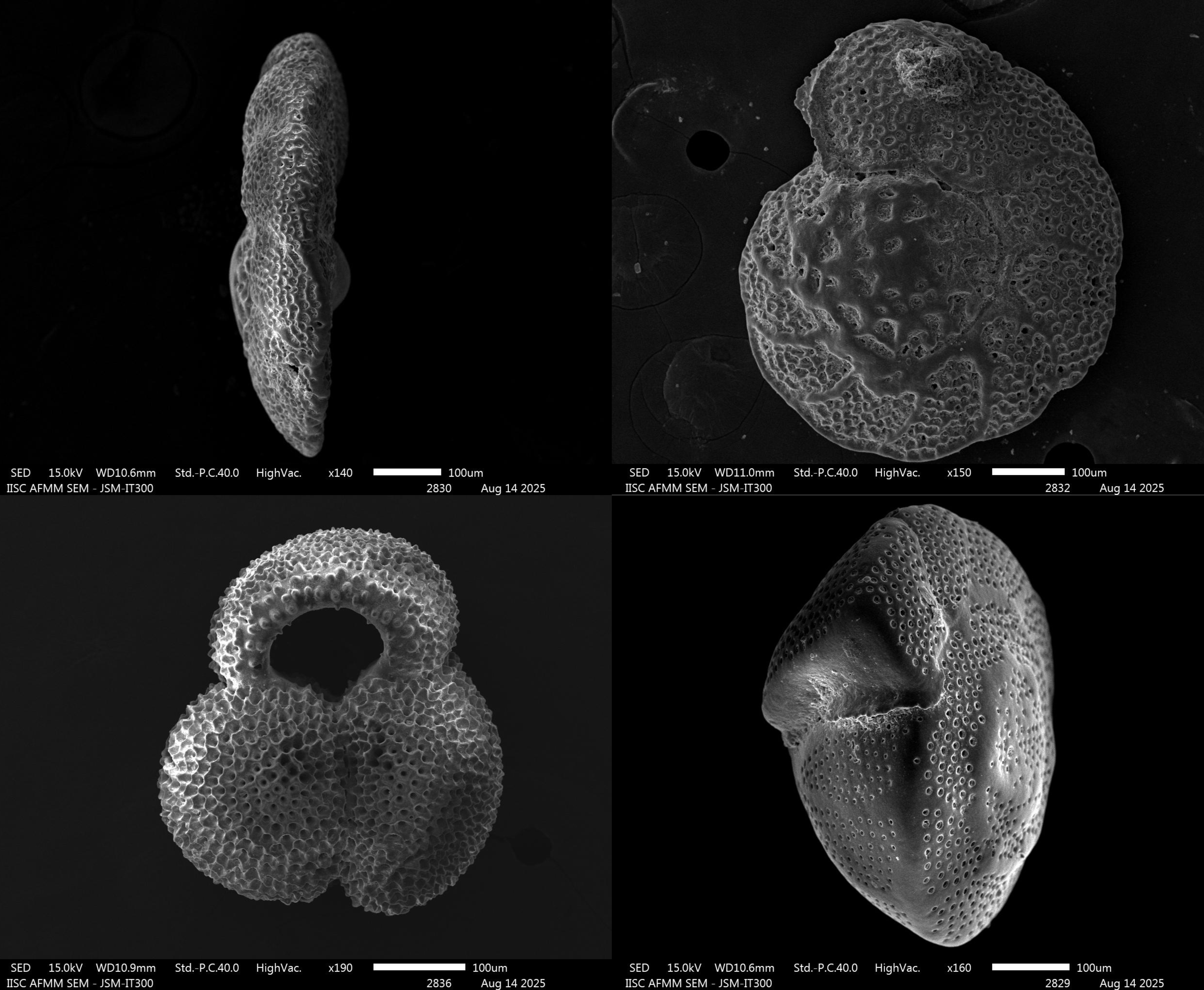
These cores contained deep-sea clay that was millions of years old – mineralogical remains from continental weathering – and countless microscopic organisms. Hidden among them were what the researchers had primarily hoped to find: the shells of foraminifera – tiny single-celled organisms that have inhabited Earth’s oceans for over 500 million years, recording all of its events.
Foraminifera live both at the ocean surface (planktonic) and on the seafloor (benthic). As they grow, they build calcium carbonate shells. When they die, these shells sink and accumulate on the seafloor, forming layered records of past oceans. The kinds of species found at a location are a clue too, as some thrive in warm waters and others in colder regions. Crucially, their shells preserve chemical traces of the water they formed in – not bad for organisms smaller than a grain of sand.
For instance, the shells store oxygen in two forms: a lighter isotope ( ¹⁶O) and a heavier one (¹⁸O). The ratio between these – known as δ¹ ⁸O – varies with temperature and global ice volume. During colder periods, when ice sheets locked away lighter oxygen, the oceans became relatively enriched with the heavier isotope. This signal was recorded on the shells as they formed.
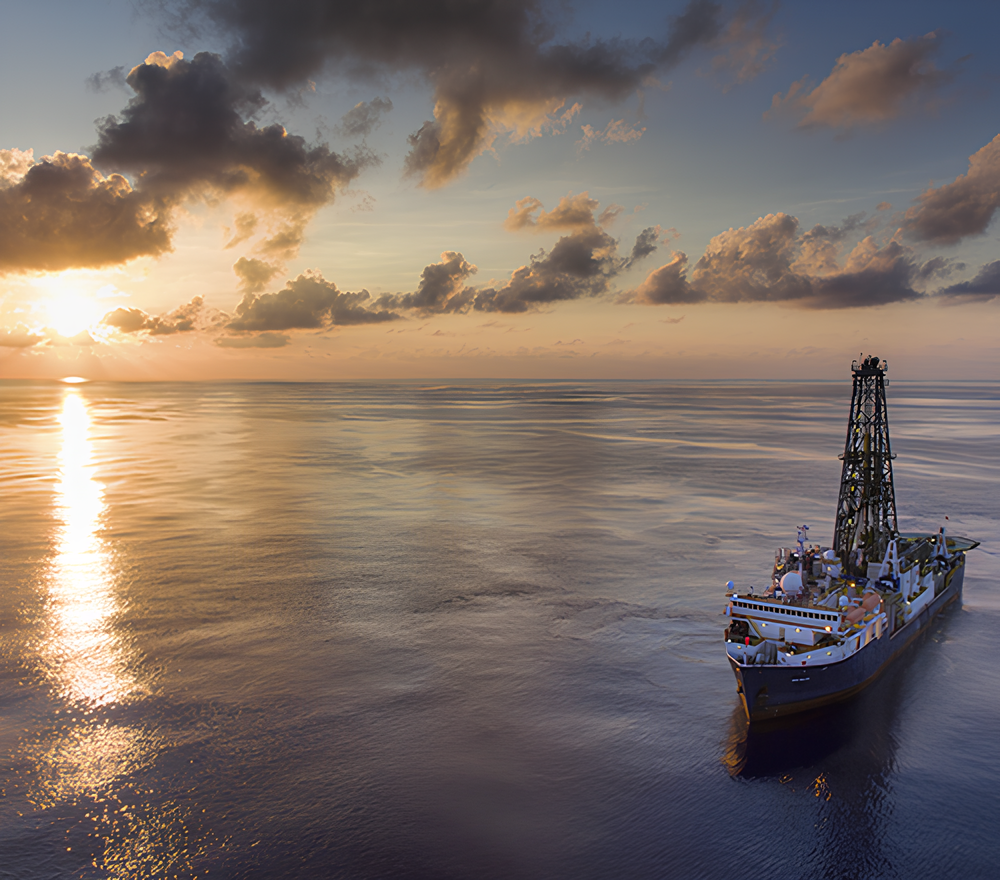
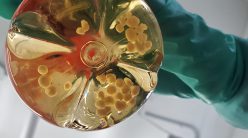
Ocean Discovery Programme (IODP), in the South China Sea, which
collected several sediment cores used for palaeoclimate research (Photo courtesy: Shuhao Xie/IODP JRSO)
Expeditions like that of the Albatross helped establish deep-sea sediments as climate archives. In the 1950s, Italian-American geologist Cesare Emiliani measured δ¹⁸ O in foraminifera from such cores to reconstruct a timeline of alternating warm and cold periods, revealing the rhythm of Earth’s glacial and interglacial cycles for the first time.
Foraminifera shells help researchers reconstruct past ocean temperatures, seawater acidity, carbon cycling, and even atmospheric CO₂
Since then, the proxies that scientists have extracted from foraminifera go far beyond oxygen isotopes. Their shells now help researchers reconstruct past ocean temperatures, seawater acidity, carbon cycling, and even atmospheric CO₂, using traces of other impurities such as magnesium and boron locked within the calcium carbonate.
Sambuddha Misra is one of those researchers. Growing up around scientist grandparents, a chemical toolbox to play with, and an innate fascination with history, he developed an interest in paleoclimate research. Well, that and a gentle nudge from his grandmother to pursue oceanography. Years into working on marine geochemistry and paleoclimate reconstruction, his work has come to focus on extracting climate signals from minute chemical impurities locked inside marine carbonates.
“In my lab, we focus on the trace metal chemistry of carbonate samples [foraminifera and corals],” he says. “The amount of impurities in them is on a nanogram scale. We try to measure its concentration and sometimes its isotope ratio to reconstruct past conditions of seawater.”
Collecting these samples is a massive logistical effort. International ocean drilling programmes send expensive, diesel-guzzling research vessels across the world’s oceans, where scientists retrieve sediment cores from depths of 3,000–5,000 metres.
Back in the lab, researchers like Sambuddha and his team extract foraminifera from the cores and rigorously screen them for signs of alteration, such as dissolution, recrystallisation, or chemical exchange with surrounding seawater – a process known as diagenesis – all of which can distort the original signal.
“It is like cooking. If you cook with bad ingredients, it will never taste good,” says Sambuddha.
Selected samples are then dated to determine when they were deposited. If it’s a short core, they use radiocarbon methods. For longer cores, they usually match the oxygen isotopes from the shells with the Milankovitch cycles – climatic cycles that track predictable shifts in Earth’s orbit around the Sun.
The team then dissolves the shells for analysis using mass spectrometry, which reveals its chemical composition for isotope analysis. From all these diverse processes emerge a set of chemical clues – temperature-sensitive ratios, pH indicators, and isotopic signatures – that must be interpreted together to reveal how the oceans have changed through time.
Chemistry into climate cues
On the other side of the world, researchers like Gavin Foster are working on similar questions.
Before Gavin stumbled upon paleoclimate research, he spent some time studying the metamorphic geology of the Nanga Parbat mountain in Pakistan in the 1990s. That is where he learned to use mass spectrometers to date rocks. Thereafter, the plasma mass spectrometer came into existence, opening up a whole new range of isotopic systems that could be measured – pushing Gavin towards more climate-based applications of isotope geochemistry.
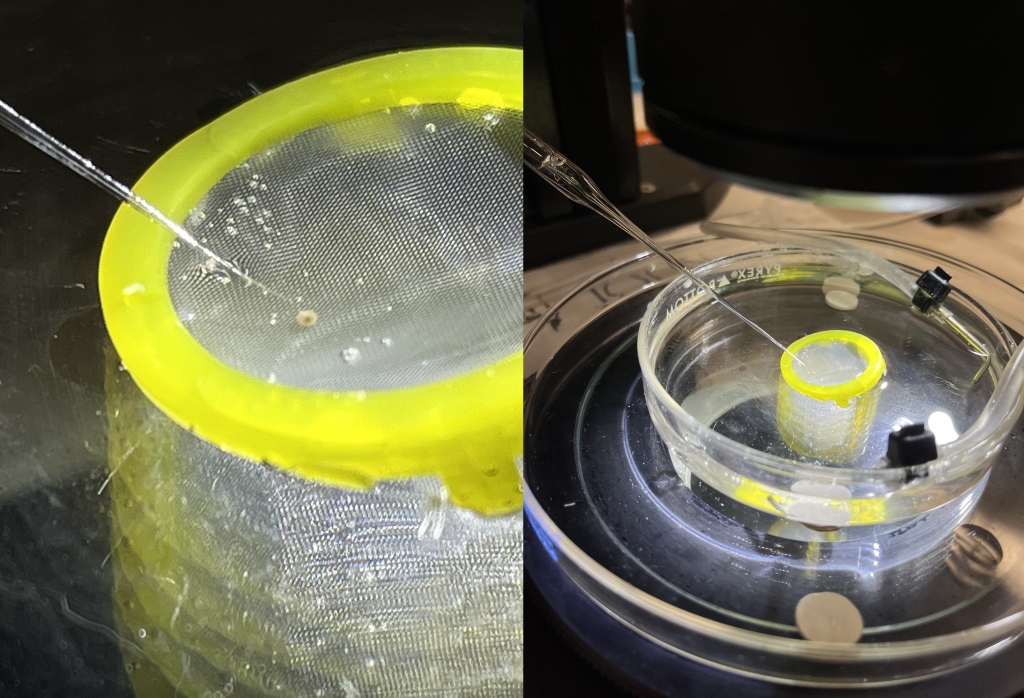
After years in the field, Gavin got hooked on using boron isotopes in foraminifera to work out past CO₂ concentrations and, from that, understand past climates and potentially predict future climates too. Boron isotopes reveal the pH of seawater. In seawater, boron exists in two forms, and the balance between them shifts depending on the acidity. As more atmospheric CO₂ dissolves into the ocean, it forms carbonic acid and lowers seawater pH. Foraminifera incorporate boron into their shells in proportions that reflect those pH changes, allowing scientists to work backwards and estimate past atmospheric CO₂ levels.
Besides boron isotopes, other chemical signatures offer complementary insights. For instance, magnesium naturally substitutes for calcium in foraminiferal shells, and warmer waters lead to higher magnesium-to-calcium ratios.
By combining such data from proxies, scientists have pieced together how carbon moved between the ocean and atmosphere, particularly during major transitions like the end of the last ice age.
Reading between the lines
For all the insights paleoclimate research has offered, it remains an interpretive science, shaped by uncertainties, assumptions, and constantly evolving methods. Sambuddha prefers the term “uncertainty envelope” – a defined range within which interpretations are built.
Part of that uncertainty stems from the ocean itself. Seawater is chemically complex, with ions constantly interacting and shifting behaviour. Even salinity is not constant through time. During the last ice age, for instance, vast amounts of water were locked in ice sheets, leaving the oceans about 5% saltier.
Such shifts influence how the proxies behave. Scientists must account for background changes in sea level, salinity, and ocean chemistry alongside the signals preserved in shells. So, the results of paleoclimatic studies are usually not a single value, but rather a constrained range within which the past most likely lies. For instance, researchers may conclude that a region of the ocean was likely between 2°C and 4°C cooler during the last ice age, rather than assigning one definitive temperature value.
What’s more, different proxies don’t always agree.
Boron isotopes illustrate this well. In some cases, they suggest relatively stable CO₂ levels even when data from other temperature proxies indicate that the planet was significantly warmer. This is because local conditions, such as temperature, circulation, and the movement of carbon-rich or carbon-poor waters, can reshape the signal. “The physical oceanography is overlaid on the chemical oceanography,” Sambuddha says. “And we are picking out organisms influenced by both.”
In one study of corals from Lakshadweep, his team was looking to assess the pH record of the Arabian Sea between 1990 and 2013. They expected a drop in seawater pH as atmospheric CO₂ rose. Instead, they observed a slight increase. The shift was driven not by global CO₂ trends, but by regional ocean dynamics linked to the El Niño–Southern Oscillation. Such contradictions between proxies are often a clue, pointing to the layered complexity of ocean systems, where chemistry and physics are both at play.
When biology shapes the signals
Other uncertainties in paleoclimate science come from the organisms themselves. Foraminifera don’t just passively record seawater chemistry; they also modify it. As Gavin explains, the shell only captures the conditions in the tiny microenvironment around the organism. “The pH that the foraminifera records is the pH in that little zone just between the foraminifera and the seawater.”
Unlike the foraminifera studied by others, Rosalind Rickaby, Chair of Geology at the University of Oxford, focuses on coccolithophores, which are photosynthetic algae that produce about half of the open ocean’s calcium carbonate. Her research explores how these organisms control mineral formation at a global scale and how their physiology adapts to changing ocean chemistry.
“The forams, by and large, are a better proxy of seawater chemistry,” Rosalind acknowledges. “My organisms (coccolithophores) are very heavily overprinted, I think, by the biology of the cell – but that is a signal in its own right.”
Before they form the shell, coccolithophores must transport all the elemental ingredients to the interior of the cell – selecting against uptake of elements like magnesium that inhibit calcification, or adding carbon to drive mineral formation. These processes leave their own chemical imprint on the final shell, thereby altering the signal.
Different organisms manipulate chemistry in different ways. Even within a single group, the individuals’ size, growth rate, and metabolism all influence how elements are incorporated. Smaller cells, for instance, tend to grow faster, and that metabolic intensity can alter the chemistry of their shells.
Additionally, over millions of years, the organisms have evolved.
Contradictions between proxies are often a clue, pointing to the layered complexity of ocean systems
Coccolithophores, Rosalind notes, have become smaller and faster-growing over time – a shift that is visible both in their fossil record and in their geochemistry. Some foraminifera, meanwhile, have grown larger, appearing to strengthen symbiotic relationships with photosynthetic organisms to survive in increasingly nutrient-poor stratified waters.
All of this complicates what seems, at first glance, like a straightforward translation of chemistry into climate. But Rosalind notes: “We shouldn’t be scared of complication. We should embrace it – it will help us create a better understanding of what these signals are truly telling us, even giving insights into past physiology.”
To filter out such distortions in the proxies, scientists combine several strategies. They select samples carefully – often restricting analysis to a single species and even a narrow size range – and compare organisms that lived in different parts of the ocean. When multiple proxies point to the same conclusion, scientists gain greater confidence in the results.
“If forams that live on the surface and forams that live in the deep, as well as coccolithophores, all record the same signal,” Rosalind explains, “you can be very sure that’s an [accurate] environmental signal.”
Why the past still matters
For Sambuddha, the lesson from palaeoclimatology is fundamental. “Through forams, scientists have uncovered [past] worlds that look radically different from our own: a time 35 million years ago when Antarctica supported rainforests, and an even earlier Earth with no permanent ice at all.”
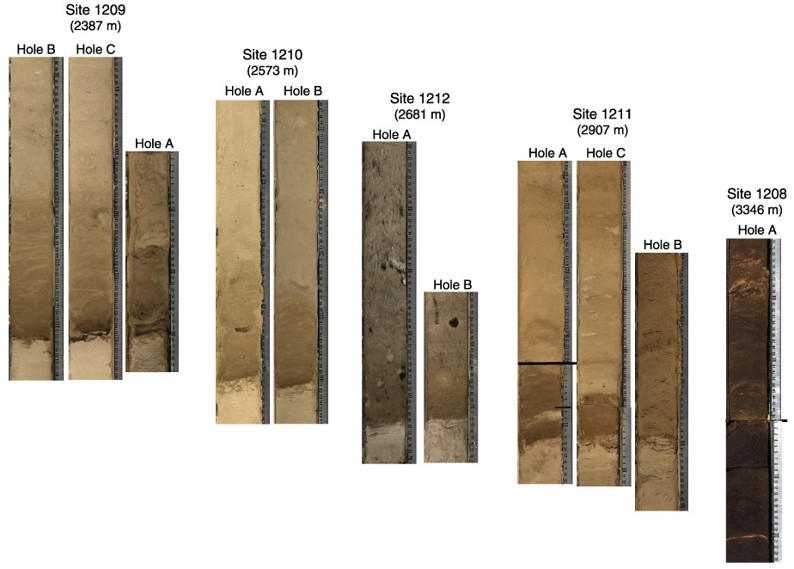
Geological records have revealed astonishing stories about our Earth’s past. Greenland ice cores have shown rapid temperature rises of roughly 10–15°C over just a few decades to centuries, possibly driven by ocean circulation patterns, says Rosalind. Some records indicate that 50 million years ago, during the Eocene, global temperatures were far higher than today, with atmospheric CO₂ levels reaching around 1,200 parts per million (today’s levels are around 431 ppm). Earlier still, during rapid events such as the Palaeocene–Eocene Thermal Maximum (PETM), massive injections of CO₂ into the atmosphere triggered abrupt warming and ocean acidification.
At its core, however, paleoclimate science is not just about reconstructing what the Earth once looked like – it is also about understanding what it can become.
Unlike digital climate models, which simulate possible futures, paleoclimate records capture physical evidence of how the Earth system has already responded to shifts in CO₂ levels, temperature, and ocean circulation.
These records allow scientists to assess how sensitive the Earth system truly is and test how well climate models capture that sensitivity when predicting future scenarios. “If the climate models get the Eocene climate right,” Foster says, “then we have much more faith in their predictions [for future climates].”
This is crucial now more than ever, as atmospheric CO₂ levels are rising faster than at any point in human history. “The power of the geological record is that it represents actual events that happened,” says Gavin. “The Earth has already run these experiments for us.”
(Edited by Abinaya Kalyanasundaram, Ranjini Raghunath)