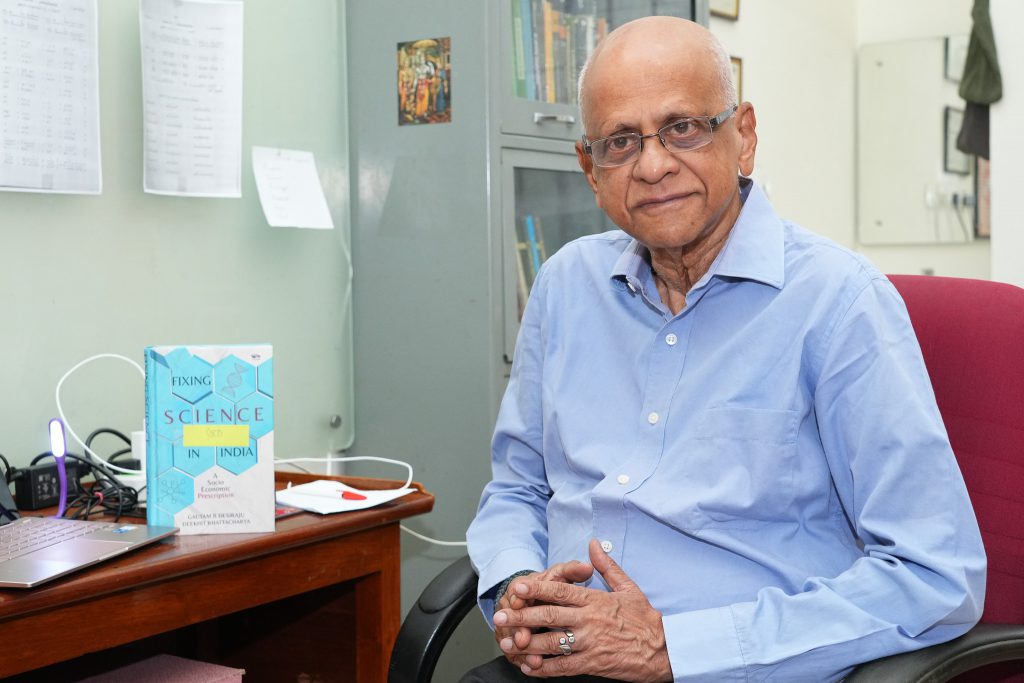
Over the past 45 years, Gautam R Desiraju has made contributions to science that have put him in a rarified international plane. A pioneer in crystal engineering, Desiraju has been at the vanguard of the field he helped create, though his interests have extended well beyond his scientific area to philosophy, history, geopolitics, and even music. In fact, he is currently working to identify the scientific bases underlying raga forms.
A Professor Emeritus in the Solid State and Structural Chemistry Unit at IISc, he has authored several scientific books, including Crystal Engineering: The Design of Organic Solids, The Weak Hydrogen Bond in Structural Chemistry and Biology, Crystal Design: Structure and Function, and has also published books that focus on Indian history and geopolitics, such as Indian Knowledge Systems – A Primer, Delimitation and States Reorganisation. Towards Better Democracy in Bharat and Bharat: India 2.0.
A winner of several distinguished awards, Desiraju spoke to CONNECT about his life and career in the world of chemistry, the philosophy of his science, his legacy, the state of science in India, and more.
How did you get interested in science? Was there an academic bent through your family background, obviously, with Dr Radhakrishnan being your grandfather?
It’s ironic that you talk about my maternal grandfather; not many of his children or grandchildren took to academics. My maternal uncle was an academic, a well-known historian in his time, but family members, at least on my mother’s side, were either doctors or civil servants and things like that. My grandfather wrote a lot about science, however.
When I was in Class 8, I liked history, geography, and science. It was a great regret of mine that when I entered Class 9, I had to choose between the science and humanities streams. Although I liked history a lot, I liked chemistry too much.
My fascination with history and geography never left me; some of the recent things that I’ve been writing have been on geostrategy. When I travel abroad and see some unusual places and things, I often think about them from the point of view of Mackinder (Sir Halford Mackinder’s Heartland Theory relates global dominance with control of the central landmass of Eurasia). I really wish I had a chance to get some more formal training in history and geography. But chemistry was nice enough.
Why did chemistry hold your fancy?
Chemistry is a very unusual mixture of the qualitative and the quantitative. Physics is very much towards the quantitative side, and large portions of biology are towards the qualitative. I call chemistry the “Middle Kingdom” – there are certain parts where one needs to be quantitative, and other parts where, unless you are qualitative, you really cannot make any headway.
What happens in chemistry is very beautiful; today’s exceptions become tomorrow’s rules
Without a good memory, I don’t think anybody should get into doing serious chemistry because you simply need to know the facts. That is the qualitative side. When you take these facts and then try to find a pattern, that’s where you get into the quantitative side. This leads to an important thing about chemistry, that there are a small number of rules and many exceptions to these rules. The rule is the quantitative part, and the exceptions are the qualitative part. That is chemistry. You have got to know when, where, and why the rule is not followed.
What happens in chemistry is very beautiful; today’s exceptions become tomorrow’s rules. Gradually, the exceptions become so many that they form a pattern of their own, and then they form a new rule, and sometimes rules that were held to be inviolate have been found to be broken. So, chemistry, that way, is a very surprising subject. It requires a peculiar type of personality to groove on chemistry.
You have spoken about the relationship between knowledge systems and chemistry. Can you elaborate on that?
This whole idea is about a holistic way of thinking versus a reductionist way of thinking. If you look at ancient civilisations, they were all holistic. Then humankind went into reductionist thinking, that is, logic, cause and effect. When you go into this, your thought process becomes more quantitative, because that is the essence of reductionism. Astronomy, (Isaac) Newton, (Robert) Boyle and (John) Dalton … the great German chemists of the 19th century; you find it is the triumph of reductionist thinking.
In the last 50-100 years, it became clear that the reductionist way of thinking could solve some problems up to some levels, and in certain problems, it could do very well. But there were other problems that refused to be solved, chiefly in the areas of medicines, drugs, and materials. The essence of reductionism is that the properties of something can be completely derived from the properties of the constituents. The whole is equal to the sum of the parts. In the holistic paradigm, the whole is more than the sum of its parts. Also, the whole is different from the sum of the parts.
Has this influenced your work with supramolecular synthons?
The supramolecular synthon is one of the ways in which I was trying to express these ideas. If you take a molecular crystal, instead of saying A+B will give you C, I say I have C, and C must be derived from A+B. I am putting the product before the reactant. Why is this kind of thinking important? Because chemistry, and all sciences, in the end must do useful things. If you can identify some material, molecule, crystal, or whatever, and identify that it has a good property, you will identify that substance C. To put it in another way, you go from property to a particular structure. This is the essential difference between reductionist thinking and holistic thinking.
If you take the synthon and then try to simplify it further, like some people have tried to do, then you lose everything, so it is a balance
So, a supramolecular synthon is that bit in a crystal that confers the property that you want. The synthon is the core or kernel of a crystal structure. It is a useful part. If you were to use a word from our shastras, it is the Bindu, a single point of convergence. My method of defining a supramolecular synthon essentially is that it was a method of simplifying something big, like a crystal structure, into the essential and not simplifying it so much that you lose the essential detail.
If you take the synthon and then try to simplify it further, like some people have tried to do, then you lose everything, so it is a balance. Everything can be broken down into finally atoms and subatomic particles. But that’s not going to help me to get a crystal of metformin, which is used to treat Type 2 diabetes.
Are synthons then a balance between holistic and reductionist?
Right, because it is holistic enough that you can go from the synthon and reconstruct the whole crystal. It is reductionist enough that, given the synthon, I will be able to find out the stuff that you need to put in to get that synthon.
Can you talk about your work in crystal engineering and co-crystals?
Co-crystals are an interesting way of looking at crystallography. The subject, which I sort of defined with many other people, mostly in the 1990s and early 2000s, is called crystal engineering. It starts from a crystallography stream – symmetry of crystals, how molecules are put together – but then it comes from a chemistry stream also – which molecules to put together and when to put them together, how do they do a handshake? To answer those questions, crystallography will help you a little bit, but mostly it comes from the chemistry side. There are certain crystals we have done a lot of work with, which are soft crystals. They will bend.
The scope of crystallography and chemistry is changing. These two are intersecting in certain very novel ways. A simple example: put a stable crystal in a computer, remove the molecules, and ask the computer to bring them back. Only in 60-70% of the cases will the computer put the molecules back in the way they were originally. That means we do not understand how these molecules come together. [Though] I would say this problem might not be that bad of late because Artificial Intelligence may be the key to solving this problem.
What about co-crystals?
The most useful place for co-crystals is in practical applications in the pharmaceutical sense. You have got drugs; they are called Active Pharmaceutical Ingredients (API). Usually, most medicines are sold in solid foundations (forms) – tablets, ointments, powders, and so on. Some have good medicinal effects but are not water-soluble. We might have to take too much of the drug to dissolve a small amount to have some medicinal effect. People found my synthon theory helpful because it is a way of expressing how molecules aggregate together. Suppose I take two different molecules. One is the drug, and one is something which is quite soluble. Suppose you make it stick together, then the soluble part, which we call the co-former, will literally drag the insoluble drug into a water solution. So, it becomes soluble enough for tissues to absorb and experience the medicinal effect. What is the soluble molecule that will stick to the drug? That is the synthon. The heart or core of that drug is that synthon, which we call heterosynthon, simply because the two molecules that are being put together are different.
You worked in the field of hydrogen bonding. Why is this area so fascinating?
Hydrogen bonding has been around for 100 years, and a great name in chemistry, Linus Pauling, is associated with it. Before Pauling, the Germans were there; they are always there in chemistry before anybody else (laughs). They called it a hydrogen bridge. Pauling said that hydrogen bonds are strong. Early in my career, in the early 1980s, I started noticing some crystal structures that seemed to defy Pauling’s ideas.
So, you were already doing crystal engineering?
I used the word crystal engineering for the first time in 1983. People tell me that I am one of the first people to use that word as the title of a paper when the subject itself was not known very clearly.
When I was looking at a crystal structure, I saw that some interactions between molecules were not strong but had a resemblance to Pauling’s strong hydrogen bonds. To form Pauling’s strong hydrogen bonds, you need atoms like nitrogen and oxygen. I found that things like C-H…O (we weren’t calling them hydrogen bonds in the early 1980s) had certain features of Pauling’s strong O-H…O and N-H…O hydrogen bonds. But C-H…O, every chemist will tell you, is weak, not strong. So, how can a weak thing have certain hydrogen-bond-like properties? Then the question is, how weak can it go before it stops being a hydrogen bond? We found that you could go quite far into the weak domain, and it still showed properties of hydrogen bonds.
I wrote a book (The Weak Hydrogen Bond, In Structural Chemistry and Biology) with Austrian Thomas Steiner in 1999 about weak hydrogen bonds in structural chemistry and biology. This biology part is very significant because biology is really where you take the rules of chemistry and apply them to systems in which interactions are weak.
Molecular biology looks at protein structures. They found that the combination of many weak bonds is more potent and useful than a few strong bonds. If you take Pauling’s strong hydrogen bonds, once it’s there, it is there; you can’t do anything with it. But suppose you get molecules put together with many weak interactions, suppose when the molecules are coming together, there are some mistakes in the way that they recognise each other. Because the interactions are weak, a few of them can get loose again. So, it has the ability to correct mistakes. That is why it is very important in biological mechanisms.
From the hydrogen bond, you moved to halogen bonding?
The thing is that the hydrogen bond itself is what we call a complex interaction. There are at least four different aspects that come into hydrogen bonding like electrostatics, polarisation, charge transfer, and so on. In halogen bonding, the importance of these four components starts changing. Today, there is chalcogen bonding and others like these. Anytime you have an electrophilic thing, you get these sorts of things. The hydrogen bond is a parent.
Do you think about the legacy you have left behind in your career?
Many scientists feel themselves lucky to be associated with a particular thing. I would say I am doubly lucky because synthon is one thing I am associated with, and hydrogen bond is another.
Normally, there are two levels of success for a scientist. The first stage is when they start associating a name with a particular area. The second stage is that you mention an area, and a name is associated to it. For both areas of crystal engineering and hydrogen bond, more so for the former, I would say my name will come up. I have done something to bring these two ideas to some level of maturity. Not that my work is the last word; scientists can never have the last word. What a scientist can do, which is what I think I have done, is sometimes to say the first word.
Interestingly, I came across a third higher level of recognition in my case. When I went to the Calgary Congress of the International Union of Crystallography in August, I was apprehensive as to how scientists 50 years younger than me would react to my physical presence in the meeting; what I mean to say is that I really didn’t know these young people, and I don’t know how they react today to anything. A colleague in my age group said that the whole idea of crystal engineering is so well known that they don’t even associate the name Desiraju with it anymore and that it would do the youngsters some good to see that I am a real person. This is life.
Where is science in India right now, in relation to other countries, as well as from where we were in the past?
In the last 10 years or so, I realised that there are many things wrong with the way science is done in India. The reasons why Indian science is not as good as it should be are not scientific in nature. The problems are economic and social. Fifty years ago, when I was coming up, science was at a primitive level because India had no money. CV Raman won the Nobel Prize. He got a grant to buy a spectrometer from GD Birla, and if you convert the money into today’s rupees, you get something like Rs 6 crore. How many people are willing to give Rs 6 crore to do an experiment today?
Raman had a very well-paying job in the Indian Audits and Accounts Service. He surrendered that job to do freelance research at the Indian Association for Cultivation of Science. I am sure Birla was impressed by this young man who gave up a job to do science. He took a leap of faith. Without good money, you cannot do good science. Not that everybody who gets good money will do good science.
World over, investment in science has come down, correct?
World over, it has come down, but there is a big difference. The USA, the UK, and Germany are all scientific giants; the buffering capacity of their scientific systems is so great that tomorrow they will make money somewhere else and put it back. We are still at subcritical. Part of the problem is that we have never been able to put science, technology, engineering, manufacturing, and public good into different silos.
‘Chemistry creates its object. It’s the only subject where we have that privilege’
In an earlier interview, you suggested focusing on undergraduates rather than further up.
China did that almost 25 years ago; they started investing heavily in integrated laboratories. Because I think chemistry, even physics, is an experimental subject. Unless you go to the lab, sit down, make the compound, have the compound blow up in your face, hear that compound exploding … it’s a very earthy subject. Chemistry is synthesis. Synthesis is chemistry. Chemistry creates its object. It’s the only subject where we have that privilege. If you want to study something, you can go and make it and then study it. It requires a very funny kind of person to do well in this subject. It can be very baffling sometimes.
In addition to science, you also write a lot about geopolitics. Does science inform geopolitics, or does geopolitics inform science?
Science originally started informing geopolitics. But today, geopolitics may inform science because it may tell the chemist what to do. We have extremely good coal in India, and it is not a particularly difficult technique to make it into natural gas. China has already overcome a great deal of its dependence (on outside countries) by making its own natural gas. Knowing about something is not the same as doing it.
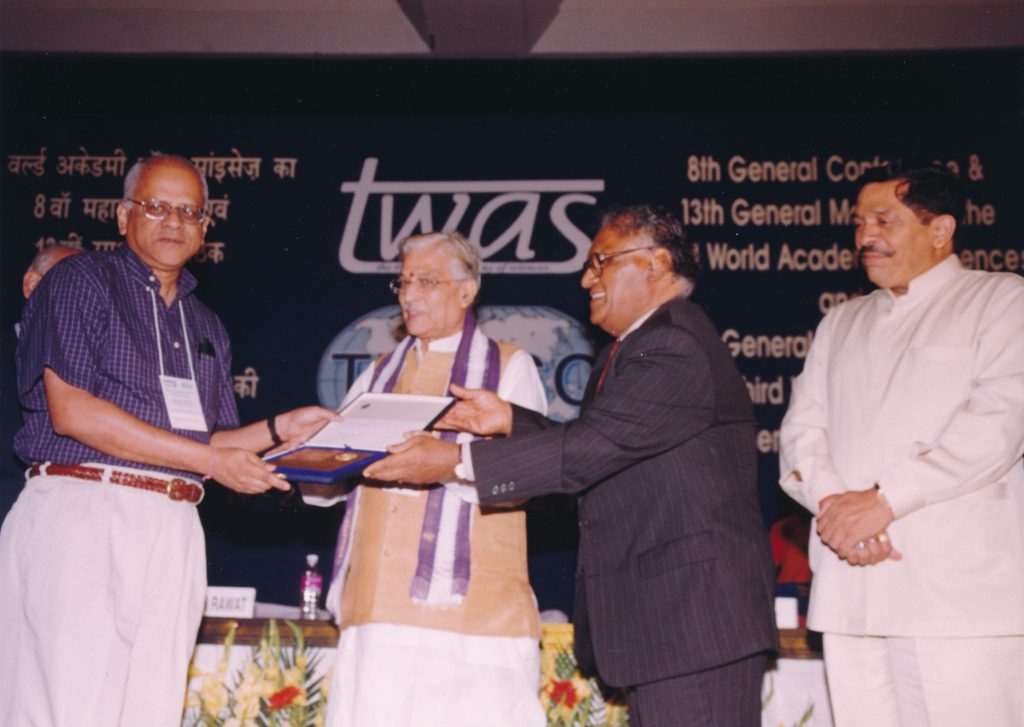
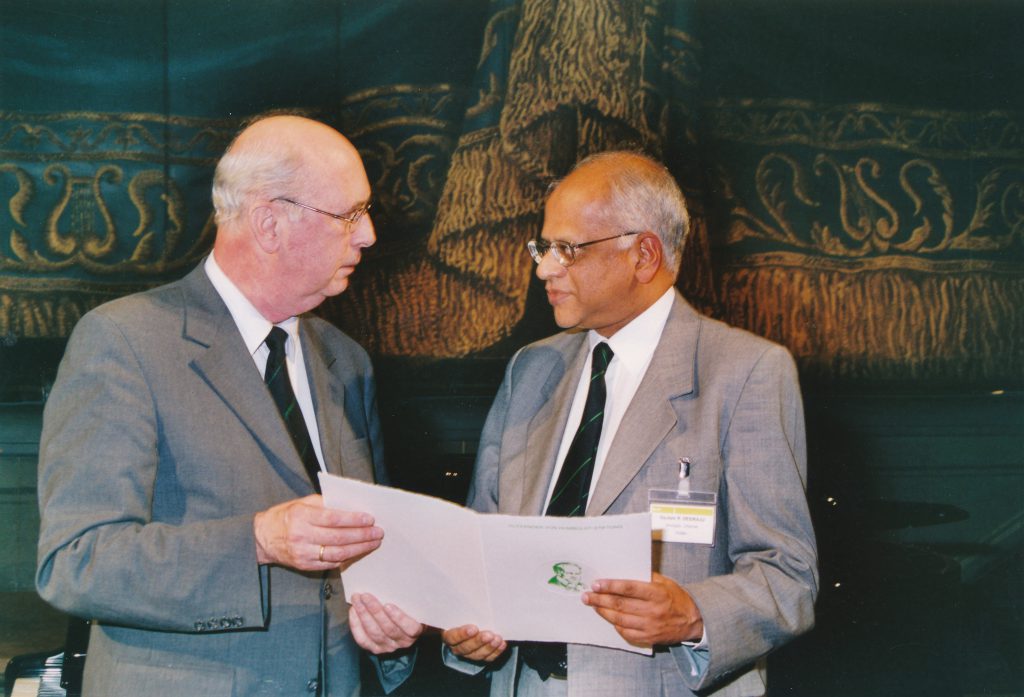
You have won several awards – the TWAS award, Alexander von Humboldt Forschungspreis, ISA Medal for Science, and now the Ewald Prize. How do you feel about getting these recognitions?
I am suitably honoured. The previous 13 Ewald Prize awardees are people I have held in very high regard. And the fact that my scientific peers have chosen me to get this award is why I really feel happy.
I always tell youngsters, the first thing you should do is write full papers for specialist journals. If you are doing serious work, the only people who should really be able to understand it are those in your own subject. Many today, including those from IISc, send their papers to generalist journals. We have a journal from the American Chemical Society called Crystal Growth and Design. The impact factor is hovering somewhere around 3.0, but you can be sure that everybody who reads it knows the subject of crystal engineering through and through. So, if you can get a full paper there, that means your immediate scientific peers think that you are doing well. Once you build upon that foundation, then you can go to generalist journals because then your work will get maturity and outreach. This is where we are really losing the forest for the trees.
We don’t know how to fix many things about science in India today. We have committed sins of both omission and commission – plenty of both. All this calls for a serious rethinking and reappraisal which we are incapable of, so fond are we of the status quo. In the present situation, I am not hopeful about the future of science in India, at least as it concerns improvements in chemistry as is being done currently in academic departments such as in IISc. I say things that others don’t like. But more often than not, I have been proved right. This is why I have received an award like the Ewald Prize.
(Edited by Abinaya Kalyanasundaram)