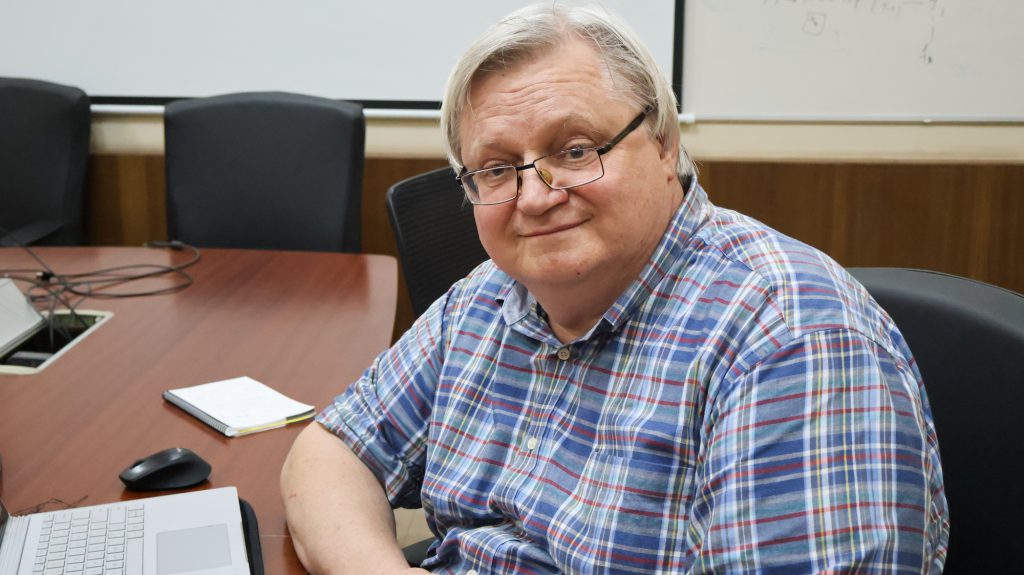
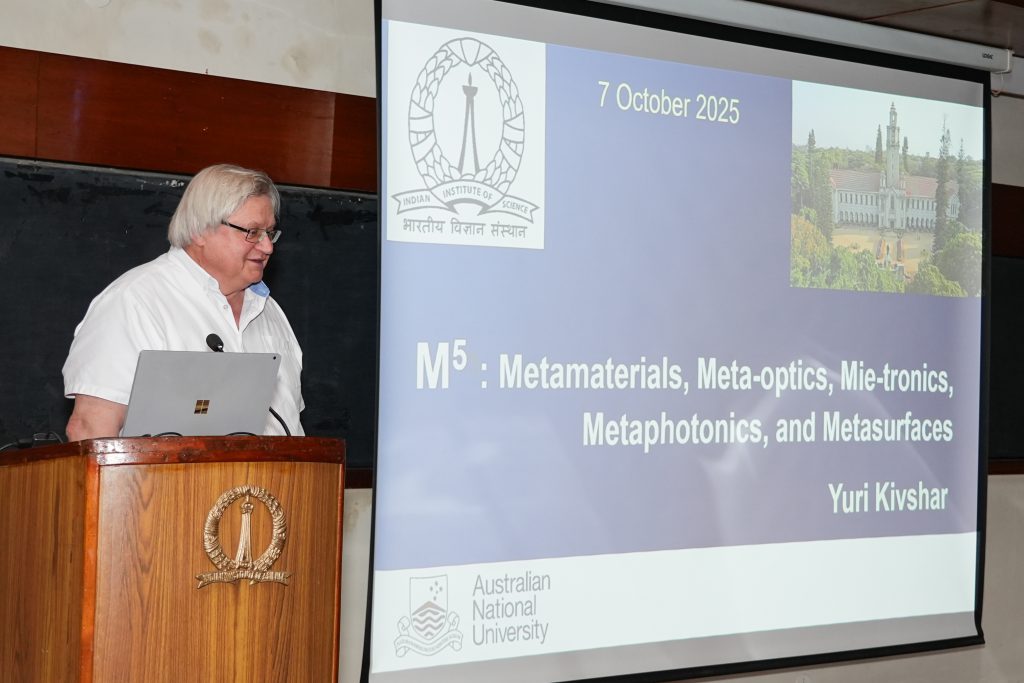
Yuri Kivshar is among the foremost authorities in metamaterials as well as nonlinear physics and nonlinear photonics, having made several pioneering contributions to these fields. The award-winning scientist is also a Fellow of the Australian Academy of Science, Optica, the American Physical Society, the International Society for Optics and Photonics, and the Institute of Physics. The Australian-Ukrainian scientist visited IISc in October 2025 to deliver talks at several departments on campus, highlighting the interdisciplinarity of his work and the wide-ranging research interests under the metamaterials umbrella at the Institute. Yuri sat down with CONNECT to speak about his work, developments in the field, his time at IISc, and his fondness for finding fellow ‘crazy people,’ among other things.
Can I start with an obvious question? What are metamaterials?
‘Meta’ means ‘beyond’ in Greek. So, metamaterials are materials beyond normal, which may have unusual properties. In our business, we are talking of electromagnetic metamaterials – materials that allow you to control light in different ways. If you take normal materials, they may reflect light, absorb it, or be transparent. But metamaterials can have properties which do not exist in nature, like a negative value for the index of refraction (an optical phenomenon in which light bends in the direction opposite to the expected).
Some ideas go back to 1968, to the Russian scientist Victor Veselago. In reality, the first structure was fabricated around 25 years ago. But then, of course, there were a lot of developments and publications. These materials are found in the military, radio waves, security screening, MRI, and now, photonics and optical applications. We are trying to implement some of the metamaterial concepts, like optically induced magnetism and negative refraction, in these devices.
So the first thought came in the 1960s. Why did they think of such a thing?
It didn’t start out as a material but as a crazy idea. It was published in Russia, not in a scientific journal but in something like Scientific American (a popular science magazine). People thought that it was a crazy idea and that it was impossible. It took some time – a team in San Diego, who knew about the paper, managed to demonstrate it. Then we all jumped onto it.
You work a lot on metaphotonics. What is that?
Initially, metamaterials were all about microwaves and radio physics … we took it to optics. The inspiration was that it had a lot of nice properties and it would be very beneficial in optics. We suggested using their optical resonances. What you do is you create structures made of very dense, high-index metamaterials, so that when light penetrates the electrics, the wavelength of light becomes lambda divided by refractive index – making it smaller. Then it can excite strong resonances to enhance properties and generate both electric and magnetic resonances. That way, we can generate optical magnetism – specific states of light which emphasise the importance of the magnetic component of electromagnetic waves. I am not sure if it is clear to everyone, but that is the idea (laughs).
What are the possible applications?
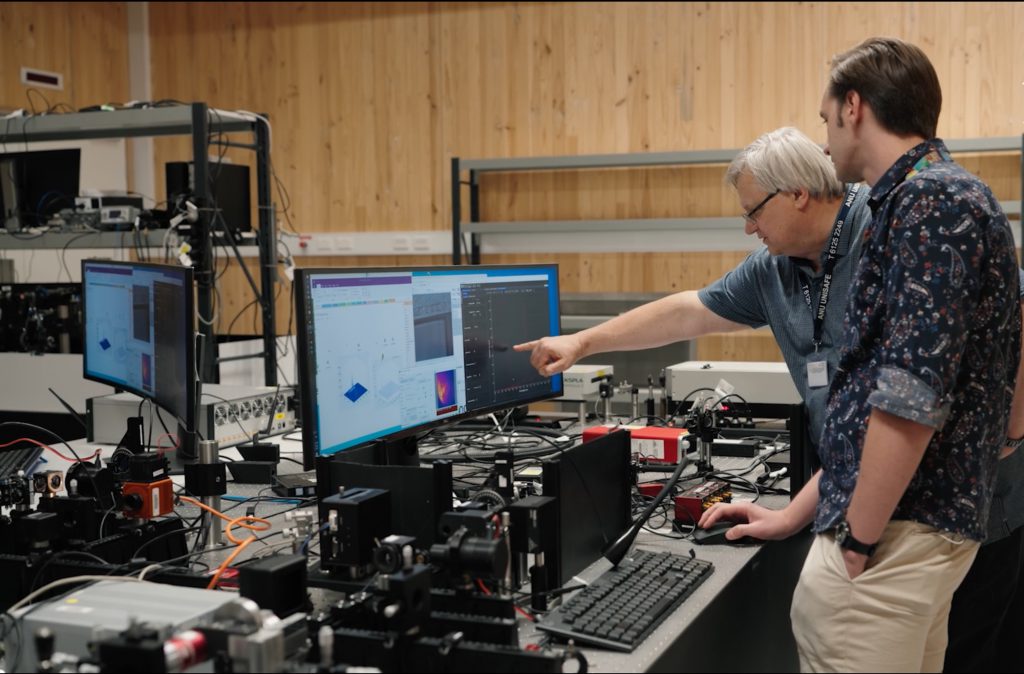
There are many. You can’t beat optical fibres in telecommunications. What you can do is that on the tip of a fibre, you can put a metasurface – a structure made of subwavelength elements. The edge of the fibre can launch different images in different modes, so instead of big devices, it can be just one properly structured layer.
You can also do this with lenses in cameras; there are many lenses in high-end cameras and you can make them smaller. They can be made with one or two metasurfaces, which can have different resonators a few hundred nanometres in size, and each one decodes different information like phase, light, wavelength, and so on. Then you can introduce many things like holograms – several functionalities can be introduced, and everything will be smaller.
We also know how to make sensors to put on our phones to check for diabetes. In principle, we can do it, but the phone will cost a lot more because the cost of fabrication is very high. However, there are several companies working on that.
‘In principle, a lot of fundamental problems have already been solved, but for implementation and application, we need cheaper technology. It takes time’
There are materials now that can learn and change properties based on exposure, right? Is that something metamaterials can do?
That is called tuneability. A normal lens has a particular focus at a distance, but with a surface metalens, you can make it very focused. In principle, a lot of fundamental problems have already been solved, but for implementation and application, we need cheaper technology. It takes time.
Do you get unexpected results while seeking to solve problems?
All the time (laughs)! New physics often comes from resonances or field enhancements inside these structures.
In 25 years, how far have we come with this technology?
We didn’t have much 10-15 years ago, but a lot of groups are working on it now. My big surprise was that since the last time I was in India, 10 years ago, there have been dramatic changes. All the scientists at IISc we talked to had international experience. They have clear ideas and a taste for science.
You’ve been in IISc for a few days now. What has your experience been like?
I gave a colloquium in the old [Main] building; there is a lot of heritage there. I gave one tutorial lecture, and I am giving two more. I try to present different things. There is a huge interest. Even if people here aren’t directly working on metamaterials, they’re exploring related areas – 2D materials, resonant structures, antennas. All of this can come under the umbrella of metamaterials.
You do a lot of fundamental research, but also serve in advisory roles …
Yeah, but I see myself as a scientist driven by fundamental research.
My question is: Is science pushing the industry, or is the industry pushing the science?
Good question. My general impression is that the industry is behind because of the cost. Thirty years ago, nothing like this existed at all. Fabrication has improved, and many facilities have come. But it is still very expensive. Industry works well when the cost is reasonable. So, at the moment, it is science-driven.
So, you are more driven towards fundamental research?
Yes, because I am having fun. I have a few grants that suggest some applications, but they don’t push me. There are different types of activities. There are those targeted for specific devices and parameters. I am targeting specific properties. I know what we want, but we have no idea what should provide these properties. So, we are doing basic research to find the type of structures that will provide the properties. We are not optimising them. We need proof-of-principle, but we are doing it at a basic level. It is exciting because it is a generation of new things. I enjoy that. That is what scientists are about.
You gave a talk about invisibility cloaks …
It was an initial hype of metamaterials. The initial concept was very nice, because you can learn how to bend light to hide objects. Usually it [works] for single frequencies and small objects. To extend it to real life takes a lot of effort and time. In principle, everything is possible; there might be some military projects (laughs).
So is this invisibility achieved by reflection, refraction, or some other properties of light?
Invisibility by negative refraction. How do you see objects? Light comes, it is reflected (off an object) before reaching my eyes. Now, imagine I put a shield around you for negative refraction: so the light bends the opposite way, going around the object instead of scattering off it.
‘Imagination is a good thing, but you still need to think about how to implement…’
You are creating fresh new materials with properties that do not exist. So are you only limited by your imagination while creating these?
Ah, interesting. Initially, it was important [to know] which material to use. We used metals and alloys, but it did not work because there was a lot of absorption. Later, we switched to electrics. Imagination is a good thing, but you still need to think about how to implement that. I should say that there are probably no limits, but there are limits in implementation because you need to think about what materials can be used, what to measure, and so on.
Do you ever wonder about the direction in which this technology is going?
There are different needs and directions – quantum technologies, defence, communications. But in the end, it all comes down to people and funding. There are not a lot of crazy people who want to do science.
My theory is simple. Every society has a certain percentage of crazy people. If you want to get money, you don’t need to be very smart. So you need special crazy people who are happy with a scientist’s salary [to] do science, do things that are fun and chase that pleasure. India might be different. With India’s large population, that percentage still translates into many passionate scientists.
I assume you are one of those crazy people?
Definitely! You ask my family, and they will agree. I work weekends and after hours …
Is it the craziness that keeps you interested?
Yeah, it is what makes me happy. I was speaking to your professors here; there are so many bright people who came back from overseas and want to work in India. One of the things we do is create ideas and pass them to others who will fabricate and implement, but I was pleased to hear from one of the guys here that he wanted to do it by himself, with his students. He is finding connections, looking for special glasses, and he found a company that makes those. He could send an order abroad, but he spent time finding it locally, and then the local companies will develop because there is a demand from science. That is what I call crazy people, and a majority of them work for free.
Can you talk about your time growing up in the Soviet Union? There is a rich legacy of science there, so what was it like?
I am from Kharkiv, Ukraine; it was a special place. I think I was very lucky. I am not doing propaganda, but you should understand that there is some kind of nostalgia. The country was closed, and there were no grants or competition. People published in normal journals, they got a salary. It was a way to work on improving your skills and knowledge while having fun. There was not much travel. We had a society which appreciated science very much, and not money. Scientific discussions and trying to find the truth were the important driving forces.
When I first went to Moscow, I was giving a seminar. If you do that here, everyone listens. But in the Soviet Union, people were quite aggressive – sometimes not for the right reasons. But you had to defend your knowledge.
People are not stupid; they might ask some questions which you didn’t think about. So, you needed to survive. The organiser told me: “If you survive for 10 minutes, believe that you are already a winner.” I survived for more than that. In the West, it is different.
‘Don’t forget about the heritage you have here (at IISc). I was really impressed by the environment and history here. It motivates the younger generation’
You left Ukraine a long time ago now, having shifted to Australia. Have you gone back?
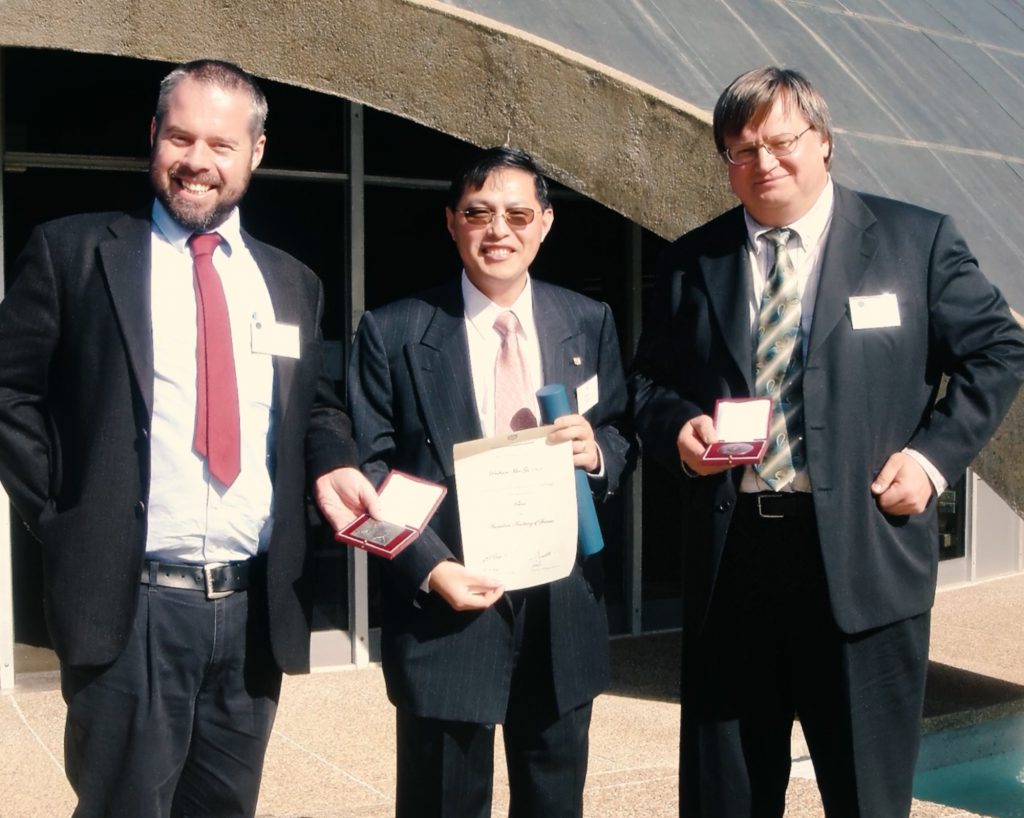
I left the Soviet Union before it collapsed, in 1989, and moved to Australia in 1993. I was in Spain, Germany, and France in between. I used to visit Russia often before the war. Now, I can’t travel there because I have a Ukrainian passport. And I can’t travel to Ukraine either because of what is happening there.
There is a lot of science happening all over. I guess someone needs to tell the stories …
That is very important. My mother was a factory worker. I liked school, but I had no idea about the profession of scientists. Suddenly, I met people who explained how [science] works. This is where you come in, connecting the public to science. Don’t forget about the heritage you have here (at IISc). I was really impressed by the environment and history here. It motivates the younger generation. And if you do that, maybe we can increase the percentage of “crazy people” to do great science.
(Edited by Ashmita Gupta, Ranjini Raghunath)