Staff who support high-stakes research
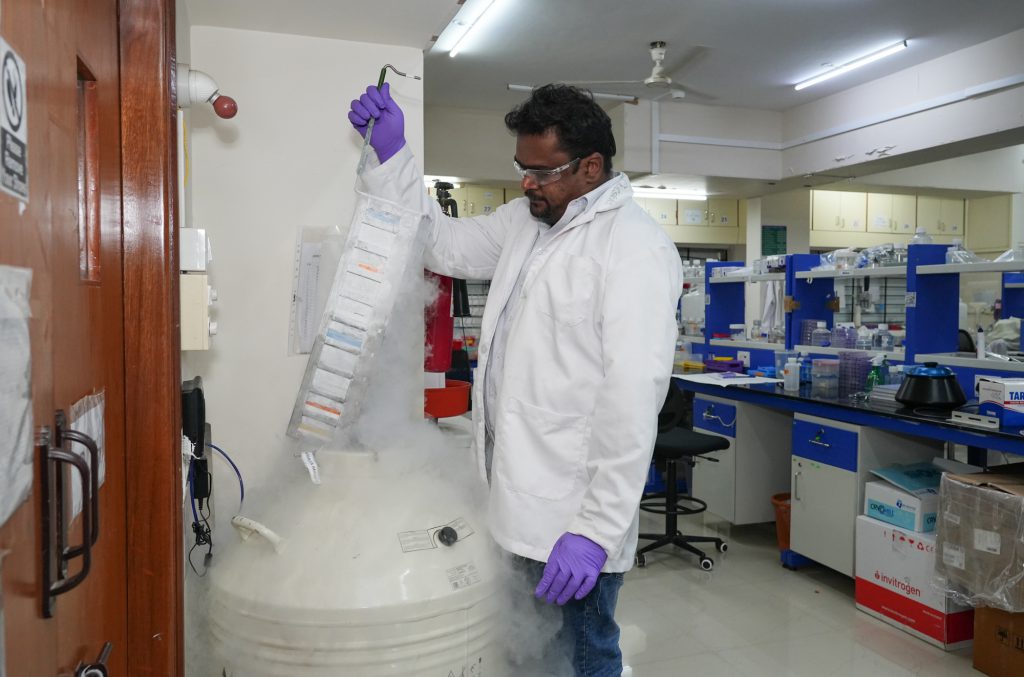
(Photo: KG Haridasan)
A long walk downhill on Silver Oak Marg leads you to the quiet edge of campus, where the bustle of the main roads fades into the murmur of trees. The air feels cooler here. Just past the Combustion Gasification and Propulsion Laboratory (CGPL), there is a gate on the left. A guard sits nearby, a friendly dog dozes beside him, and white Datura blossoms lie scattered on the road like fallen stars. The scene is tranquil, almost deceivingly so, because just beyond this stillness stands one of the most secure and high-stakes spaces on campus.
Past the gate, on the right, a modest building comes into view, pale and unassuming, with an entrance that requires biometric access. Inside, staff members move briskly through the corridors, exchanging notes, carrying equipment, planning the day’s routines. Its corridors carry the sharp tang of disinfectant, the occasional hiss of a gas cylinder being changed, and the steady whirr of freezers holding biological samples at -80°C.
The Centre for Infectious Disease Research (CIDR) is one of the youngest research spaces on campus – a place where scientists study infectious agents such as Mycobacterium tuberculosis, HIV, SARS-CoV-2, and other viruses that cause diseases like the flu, hepatitis, dengue, and Zika. Though the Centre, in its current form, was inaugurated in 2013, its roots go back over a decade earlier when IISc’s first infectious disease research initiative was launched in 2002. “CIDR stands as a critical national resource dedicated to tackling some of the world’s most urgent health threats,” says KN Balaji, the centre’s Convenor and Professor at the Department of Microbiology and Cell Biology (MCB). “It enables scientists to safely and rigorously study these dangerous microbes and accelerate the development of much-needed diagnostic tools, therapies, and vaccines.”
‘CIDR stands as a critical national resource dedicated to tackling some of the world’s most urgent health threats’
To make such research possible, CIDR houses multiple Biosafety Level 2 and Level 3 (BSL-2 and BSL-3) labs, each designed to handle microbes posing varying levels of risk. In the BSL-2 spaces, pathogens that pose a moderate risk are handled with protective lab gear and sealed safety cabinets. The BSL-3 labs, however, are engineered for more stringent containment – sealed rooms maintain negative air pressure so that nothing escapes, HEPA filters purify every breath of air, and double-door autoclaves and air showers separate clean zones from contaminated ones. Inside, researchers in layered protective gear carry out their experiments surrounded by the steady hum of instruments and safety monitors.
In addition to advancing infectious disease research on campus, CIDR also functions as a collaborative centre, sharing its high-containment infrastructure with researchers from other institutes, according to Balaji. In recent years, it has become home to three independent labs filled with doctoral students, project assistants, and postdoctoral researchers, bringing an academic rhythm to this research space. “Essentially, CIDR is not just studying future pandemics, it is actively empowering the wider scientific community to develop solutions for pressing public health concerns,” adds Balaji.
What also keeps this carefully controlled environment running is the commitment and hard work of several staff members, some of whom have been with CIDR from its early days. Among them is Bharathi Dakshinamurthy, a former staff member, who remembers a time when the building had neither sound nor science – only dust, silence, and the promise of what it could become.
From the ground up
Back in June 2013, when Bharathi first stepped into what was to become the CIDR building, she felt an overwhelming sense of desolation. “There was nothing – not even chairs or tables,” she recalls. “We carried furniture and bookshelves from the Dorabji Tata Centre.” The Sir Dorabji Tata Centre for Research in Tropical Diseases, earlier housed on the first floor of the Society for Innovation and Development (SID) building, had just closed, and many of its items were moved to CIDR. Slowly and painstakingly, the skeleton of a research facility began to take shape.
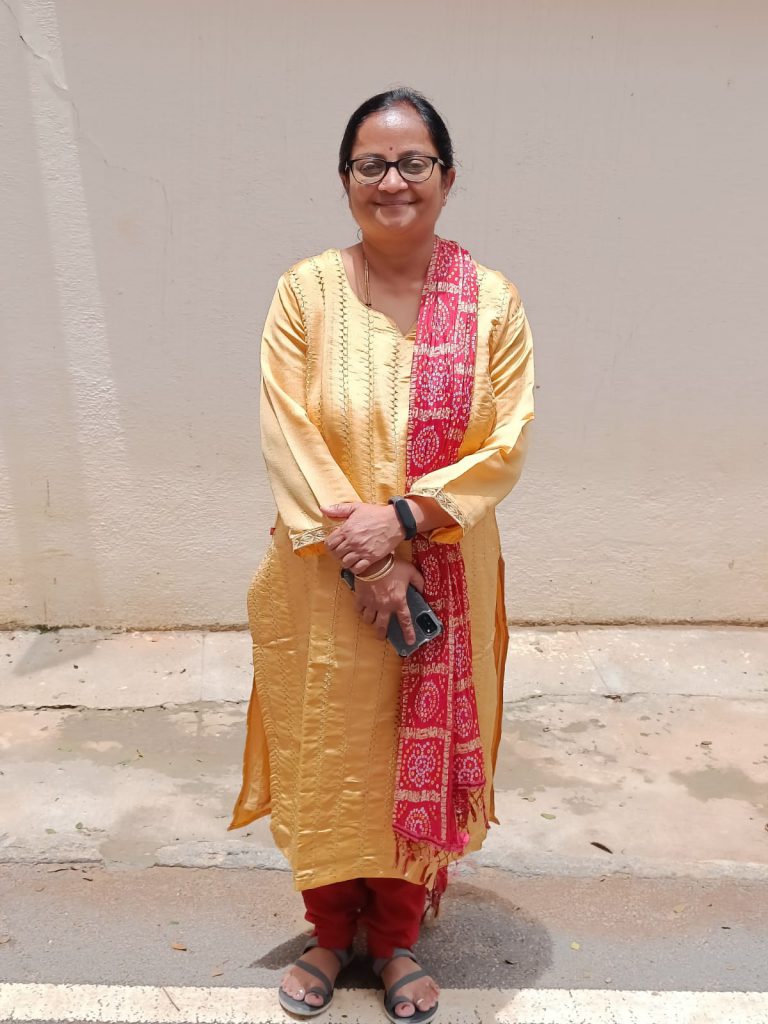
2013 until her retirement (Photo courtesy: Bharathi Dakshinamurthy)
Snakes would sometimes slither in through the gates, and dust hung heavily in the air. There was no bio-waste system, no safety office, and for a while, no generator. “Whenever the power went out, we rushed with samples in ice boxes to the [nearby] animal centre,” she says. Even after the generator came, the wiring was confusing, with power coming from multiple substations. “We had to keep track of everything,” she adds. In those early years, under the guidance of the founding convener Dipankar Nandi, Professor at the Department of Biochemistry, and Amit Singh, Professor at MCB, CIDR began establishing its first BSL-3 lab, which opened for tuberculosis research in 2014. Over the next few years came the Animal BSL-3 (in 2017), then the construction of new labs funded by a grant from the Infosys Foundation (in 2019), and finally, the viral BSL-3 facility (in 2020). Through every phase, Bharathi helped manage purchases, coordinate logistics, and worked to ensure every detail, from chemicals to compliance documents, was in place.
When the pandemic hit in 2020, her responsibilities multiplied overnight. “I worked all the days; even caught COVID-19 myself, twice, maybe thrice,” she recalls. The central government had instructed IISc to set up a COVID-19 diagnostic lab. What followed was a collective effort – guided by the Divisional Chair and faculty members, including faculty members Amit Singh, Shashank Tripathi, and Deepak Saini and supported by several postdoctoral researchers who were on campus then. “We set up the diagnostic lab on the second floor of the Infosys wing,” Bharathi adds.
‘I worked all the days; even caught COVID-19 myself, twice, maybe thrice’
Those weeks felt endless, she recalls. Vendors supplying consumables and kits for the diagnostic tests were scared to cross police checkpoints in the city and deliver them inside the campus. “One said, ‘Madam, the police will beat me up,’” Bharathi recollects. “I wrote hundreds of permission letters, stamped and signed, convincing them that it was safe.” She also arranged PPE (Personal Protective Equipment), diagnostic kits, and even snacks for people working late at night. “It was chaotic, stressful, and unforgettable.”
Bharathi is happy at how far CIDR has come. “Compared to big departments, we grew very fast. When I joined, it was just snakes and us. In 12 years, it has become so big.”
Running around
It was Bharathi who brought Ramesh KC to CIDR in 2014. A friend had introduced them, and soon after, she asked him if he would consider joining their small team. “Only Bharathi madam and Yathiraj [another staff member at CIDR] were here when I joined,” he recalls.
Ramesh’s journey to IISc has been far from straightforward. Before coming here, he had worked in fabrication shops, a cloth store, and later in a software company that maintained ATMs. After joining CIDR, he began working on general maintenance and cleaning – connecting gas cylinders, checking incubators, autoclaving waste, and ensuring that the labs stayed functional. Over time, his responsibilities grew. Today, he handles the upkeep of the viral BSL-3 facility, oversees power systems, and coordinates with the maintenance team of the biosafety labs.
Ramesh dislikes sitting idle. His day begins around 9.30 am and often stretches well past evening. If a power line trips or a diesel tank runs low, he stays back until the problem is fixed. He also assists in the animal BSL-3, where strict protocols need to be followed to ensure that nothing harmful leaves the facility. “If an animal model dies, we freeze it, autoclave it, and only then discard it,” he explains. During the pandemic, Ramesh remembers receiving COVID-19 samples for analysis at odd hours, whenever the calls came.
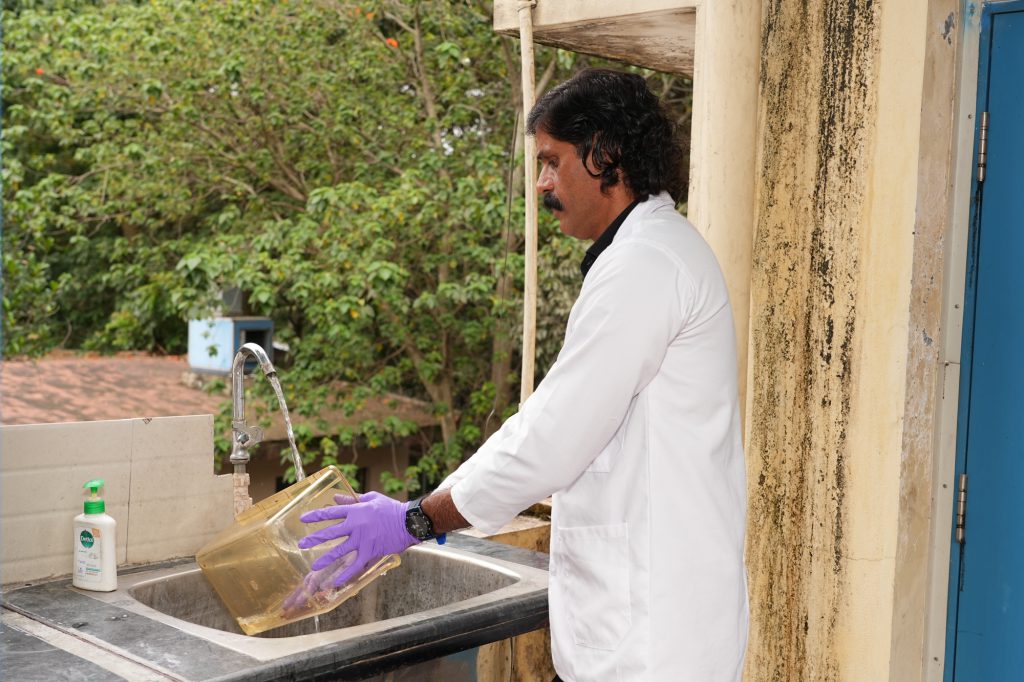
On festival days, when the staff, students and faculty members gather together, Ramesh enjoys the brief sense of pause. “Those days feel good,” he says, his eyes brightening. Even on other days, he adds, that sense of shared responsibility endures. “We support each other and get things done.”
Outside of work, Ramesh has a fascination for languages. He speaks Kannada, Tamil, Telugu, Malayalam, Hindi, English, and even understands bits of Marathi and Rajasthani – picked up over years of talking to people from across the country. “If you know many languages,” he says, “you can talk to anyone.”
Fixing things
As Ramesh prepares to get back on his rounds, he is joined by S Sendil Raj, another staff member. Sendil grew up inside the IISc campus. His father had worked here decades ago, and Sendil himself was born on campus. He now lives just outside the D gate.
Sendil joined CIDR in 2015 from the Department of Developmental Biology (DBG), where he worked in faculty member Upendra Nongthomba’s lab. Around that time, faculty member Amit Singh was setting up his lab at CIDR, and through that connection, Sendil moved into the new building. He started his journey as a lab attendant in Amit’s lab, and over the years, became the go-to person.
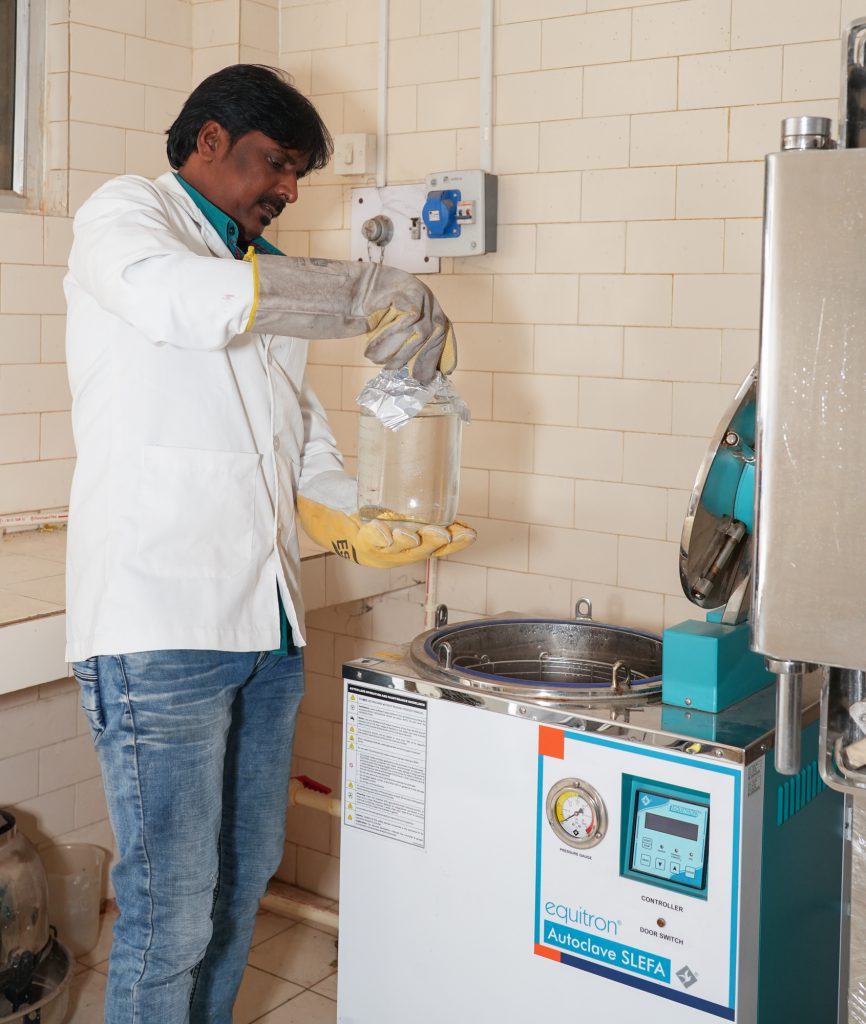
If the autoclave breaks down, he fixes it. If the CO₂ cylinders run low, he replaces them. When the power fails, he’s the one refilling diesel in the generators. He handles liquid nitrogen, prepares cleaning reagents, checks the incubators, coordinates billing, and even manages paperwork when needed. “I do almost everything in the lab,” he says, with a laugh.
Sendil’s workday rarely fits in a nine-to-five frame. He comes at 10 am and often stays past 6 or 7 pm. “Sometimes there’s emergency work at night,” he says. “If the generator runs out of diesel or a burning smell comes from a wire, we have to go immediately.”
His job was even more demanding during the pandemic. “We sanitised labs 5-6 times in a week. We wore double masks and PPE kits even outside the BSL-3 lab for hours. Everyone was scared.” He still recalls his neighbours eyeing him warily, as if he carried the virus home in his pocket.
Sendil has worked across campus for over 30 years, from the Department of Biochemistry to the Animal Centre to DBG, where he still helps with Drosophila media preparation in the evenings. Outside of work, he’s an active presence in campus sports – often seen on the badminton court or at the swimming pool, where he once coached faculty members and their children. Like Ramesh, Sendil echoes the sense of togetherness he feels with the other staff members at CIDR. “If one person can’t come, the other does the work. We don’t say, ‘this is your job, that is mine.’”
Sendil is also well-regarded among the students. “They get along with me very well. If they need anything, I’m always ready to help.” After a decade of working at CIDR, he remains deeply attached to the place. “I got many offers. Better pay too. But I never left. This place feels like home.”
Balancing science and safety
Soon after Rohan Narayan joined IISc as a postdoc in December 2019, COVID-19 hit. The timing turned out to be critical – it was when CIDR’s viral BSL-3 began coming up. Before arriving in Bengaluru, Rohan had already spent years immersed in the world of viruses. He earned his PhD from Cardiff University in the UK, working on the dengue virus, which gave him both technical experience and biosafety training in high-containment environments. That expertise would soon become invaluable.
At IISc, Rohan’s postdoctoral research naturally aligned with managing the viral BSL-3. “It was not officially part of my job description,” he explains. “But since I was already familiar with BSL-3 systems and interested in them, I took it up.”
As one of the first researchers to work in the facility, Rohan helped shape its functioning from scratch – helping draft standard operating procedures, setting up safety protocols, and training users. “Using the guidelines available from ICMR, CDC, and WHO, we developed SOPs and adapted them to our settings,” he says.
Managing a BSL-3 lab is far from routine. Each day involves coordinating with CIDR staff, the BSL-3 construction agency staff, and faculty-in-charge, Shashank Tripathi. Rohan’s role involves ensuring biosafety compliance, monitoring research instruments, and supervising users. He now works closely with Balasubba Reddy, a Technical Assistant who joined CIDR in 2023 and helps oversee the BSL-3 operations – from checking incubators, freezers, and temperature controls to monitoring negative air pressure systems. He also handles service calls when equipment fails, manages billing and user access, and coordinates maintenance visits. “Every day is different,” he says. “Some days are smooth, some days can get hectic – especially when the power goes.”
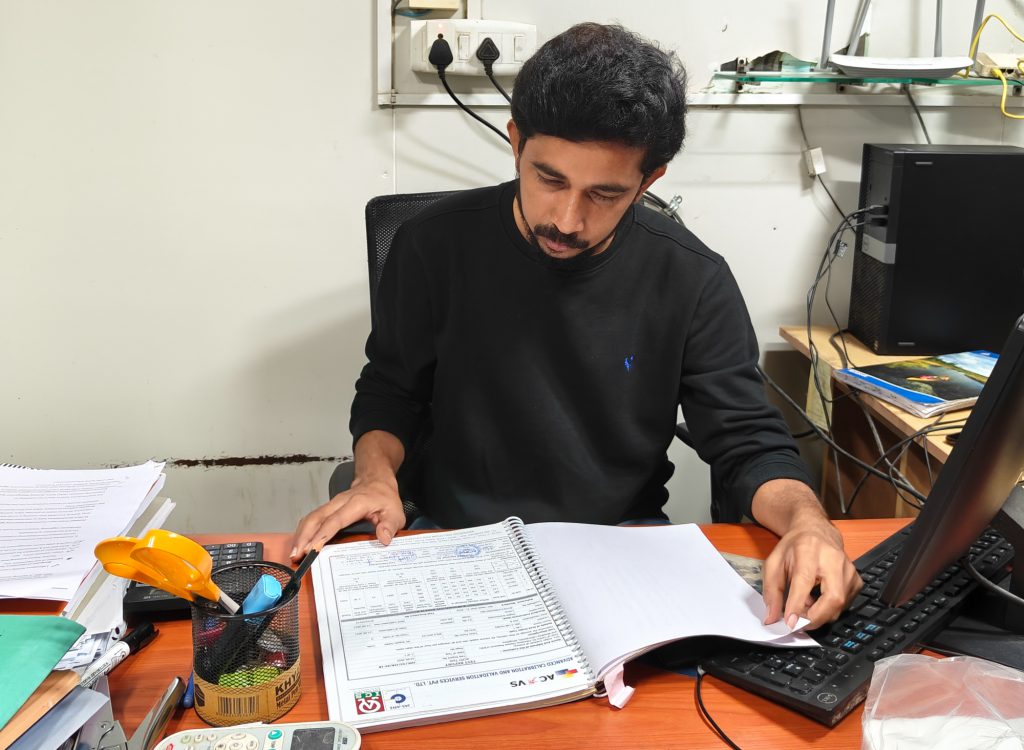
Rohan stresses the importance of following biosafety rules. “Whatever is inside must not leave the BSL-3 lab without complete sterilisation – and you have to protect yourself, too,” he adds.
To him, the BSL-3 lab runs more on collective effort than hierarchy. The cleaning staff, maintenance engineers, and researchers all play a crucial role. “It’s a team effort,” he says.
He personally trains every student who enters the facility – from donning and doffing PPE to handling spills and emergency procedures. Inside the BSL-3 lab, the physical and safety constraints make even simple experiments arduous. “Wearing PPE can be a little uncomfortable, and everything takes longer inside BSL-3, but you have to strictly follow the rules,” Rohan points out.
The BSL-3 lab runs more on collective effort than hierarchy. The cleaning staff, maintenance engineers, and researchers all play a crucial role
As part of the COVID-19 response, he and other researchers worked to isolate the SARS-CoV-2 virus from patient samples. Using Vero cells (mammalian cell lines used to study viral infection), Rohan watched the infection unfold under the microscope in real time – infected cells fusing into large clusters called syncytia. “It was a stark reminder of what the virus does in the body,” he recalls.
Those months of the pandemic were a mix of intensity and isolation. “It was lonely,” he admits, “but there was so much work. I was busy most of the time.”
Five years on, Rohan continues to balance his postdoctoral research with his managerial responsibilities. “It’s been a constant learning experience,” he reflects. “During my PhD, I just worked in a facility. Here, I helped build one.”
When the lights dim at CIDR and the last centrifuge hums to a stop, the building does not fall silent. Ramesh checks the power lines one last time before heading home, the careful click of switches marking the end of his day. From the corridor outside Amit’s lab, Sendil’s laughter floats softly through the air. The centre’s pulse continues in the quiet movements of the staff members who deeply care about it.
Shruti Sharma is an Integrated PhD student at the Department of Biological Sciences, IISc, and a science writing intern at the Office of Communications
(Edited by Ranjini Raghunath)