Is it dead? Is it alive? Surely it has to be either, right?
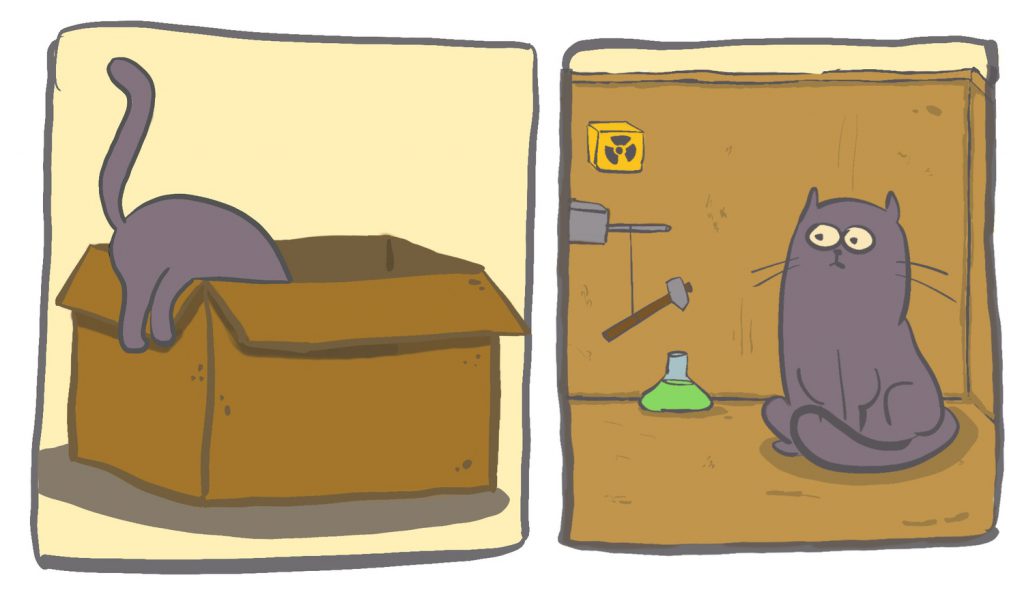
Consider a cat in a box – let’s call him Meownstein. Along with him inside the box, there is a radioactive sample (which can decay to produce radiation) and a poison vial with a radiation sensor. If the sample decays, the sensor will break the vial open, killing Meownstein. If not, he lives for another day.
Radioactive decay, however, is not simple; it depends on the stability of the core of the atom, called the nucleus. The subatomic particles within the nucleus are not governed by the classical laws of physics, such as the intuitive Newton’s laws of motion. Instead, their rules are set by quantum mechanics. Quantum laws are all about probabilities – they cannot predict how these particles will exactly behave, but they can suggest how they could behave.
Thus, quantum mechanics lets us precisely calculate the probability of the sample decaying, and hence our cat surviving. But it cannot say for sure if and when exactly it will happen. Until one opens the box, the sample could both have decayed and not decayed, and Meownstein could be both dead and alive.
Quantum laws are all about probabilities – they cannot predict how these particles will exactly behave, but they can suggest how they could behave
This is not the physical reality that we are familiar with – last we checked, cats are usually either dead or alive, and often, hopefully, the latter. In 1935, in a letter to Albert Einstein, Austrian-Irish physicist Erwin Schrödinger proposed this scenario as a thought experiment, to expose one of the many situations that are allowed mathematically by quantum mechanics but seem absurd in our classical view of the world. Since then, Schrödinger’s cat has become one of the most popular thought experiments in theoretical physics, appearing in T-shirts, science fiction shows, and even smileys – “:):” looks both happy and sad at the same time.
Over the years, physicists have tried hard to explain Meownstein’s fate in a fashion that we can comprehend. Quantum laws apply to subatomic particles, but everything in this universe – including cats and humans – is made up of these particles. Surely then these laws should apply to the larger, macroscopic world as well? These attempts to reconcile quantum mechanics with our experience are known as “interpretations of quantum mechanics,” but physicists still disagree on which interpretation is correct, or if they are even needed.
“All the interpretation problems of quantum mechanics arise from trying to convert the quantum theory to a classical description, while it is known from the outset that it cannot be done,” says Apoorva Patel, Honorary Professor at the Centre for High Energy Physics, IISc. “Quantum theory only produces correlations (relations between variables) and not absolute results. Trying to convert [correlations] into absolute results causes problems of interpretation.”
Nevertheless, the interpretations have endured, as they essentially attempt to answer the one question that quantum mechanics could not. Suppose you open the box and, luckily, find that Meownstein is alive, what was his state just before you opened the box?
Before closing the box
Before grappling with Meownstein’s fate inside the unopened box, let’s go back to the basics.
What do you picture when you hear the word “electron”? Till the 20th century, physicists thought of electrons, or other subatomic particles, as very tiny hard spheres hurtling through space. At any instant, these particles have a definite position and a velocity.
Quantum mechanics, however, provides a completely different picture. In 1924, French physics graduate student Louis de Broglie imagined that maybe, just maybe, particles behave like waves. Much like light, which behaves both like a hard sphere and like a wave, physicists describe electrons using an all-important mathematical quantity called the wavefunction. So, instead of a moving hard sphere, imagine a moving cloud that can constantly change its shape.
But what exactly is this electron cloud – described by the so-called wavefunction – made of? Schrödinger, who first formalised the idea, believed that it was a spread-out charge density. German-British physicist Max Born later corrected this, interpreting that a particle’s wavefunction can tell you where the particle could be. It allows us to calculate the probability of finding the particle at a particular location, but it cannot accurately predict the particle’s location. This is the probabilistic nature of quantum mechanics.
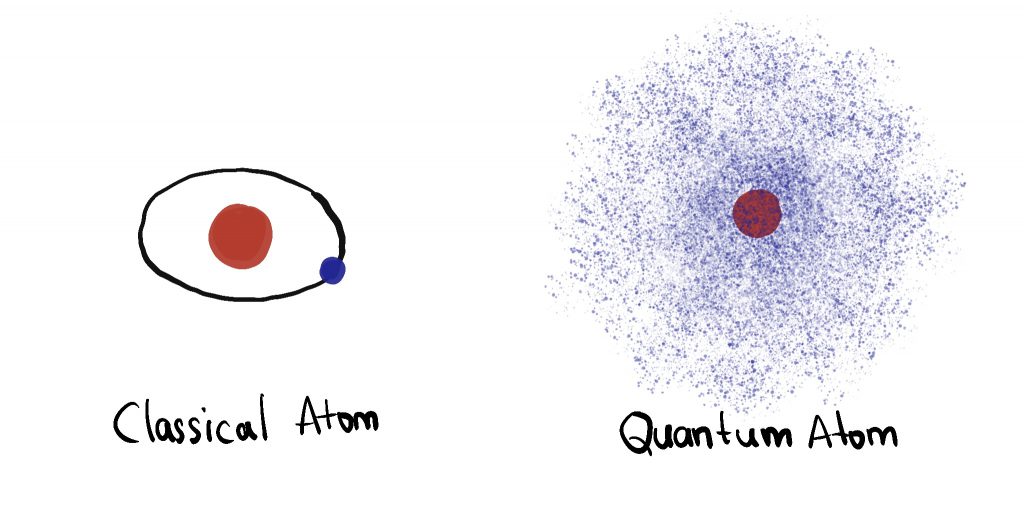
Thus, these clouds exist in a superposition of many positions – the particles are in a blend of all the states that they could be in. Multiple clouds can also be bonded via an invisible link, such that affecting one immediately affects the other, even at a distance. This is called quantum entanglement.
According to the most widely accepted interpretation of quantum mechanics, the radioactive sample’s decay and the cat’s fate are inextricably entangled
Now, back to the cat in the box. According to the most widely accepted interpretation of quantum mechanics, the radioactive sample’s decay and the cat’s fate are inextricably entangled – until we know about one, we cannot predict the other. And since we can never know for sure whether the radioactive sample decayed or not, we cannot predict the cat’s exact fate before opening the box. This view was called the Copenhagen interpretation, the culmination of the philosophies of Niels Bohr, Werner Heisenberg, Max Born and others during 1924-27. Named after the city where Bohr and Heisenberg worked, the idea of this interpretation was to essentially give up on reality.
According to this, before you open the box, Meownstein’s state has no classical, real-world analogue; only mathematics can help us comprehend it. As the sample is in a superposed state of decayed and not decayed, Meownstein is also in a superposed state of both dead and alive, but not entirely either.
“Every interpretation arises by adding something extra to the mathematical theory,” says Apoorva. “And in the Copenhagen case, this is the observer.”
According to the theory, when an observer opens the box, Meownstein’s fate is immediately decided. They are the one bringing him to life, or if they’re unlucky, the one who kills him. This is called quantum collapse – an ad hoc, instantaneous, destructive process that one triggers simply by opening the box and making a measurement. As long as one doesn’t open it, the cat remains in a superposition.
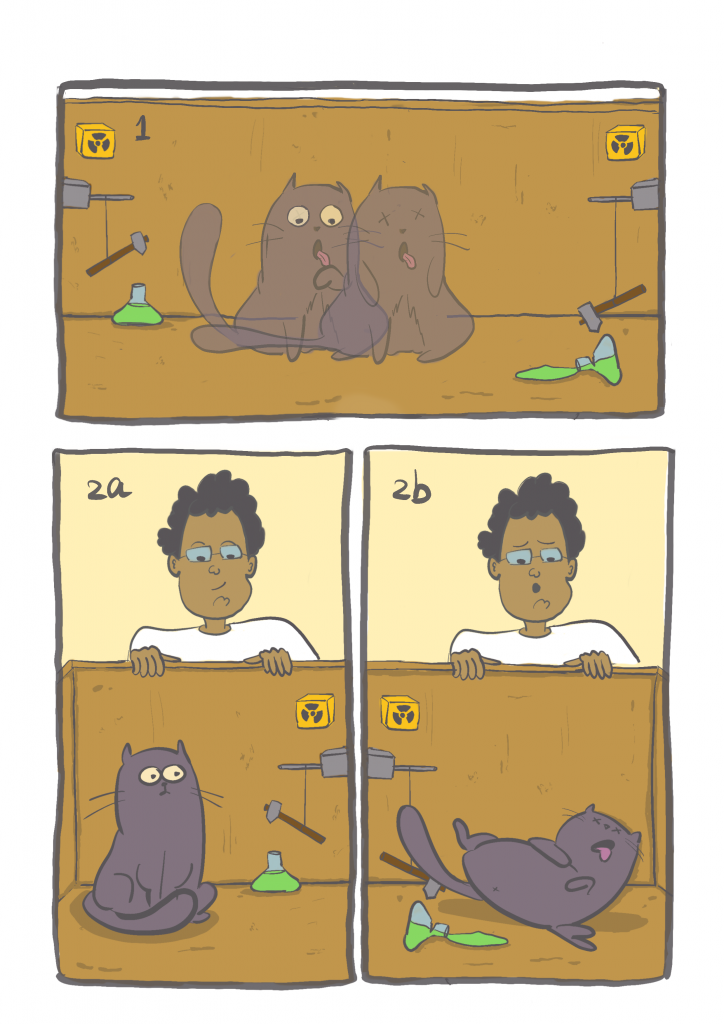
But how can something like Meownstein – a living, breathing furball of cuteness – be both dead and alive, and yet neither? Yet quantum mechanics, at least mathematically, allows for this to happen. This is the underlying reality of our world, according to the Copenhagen interpretation. “You just have to accept the extra features of quantum mechanics and live with it,” says Apoorva.
Schrödinger, however, did not fully agree with this interpretation. In fact, he devised the whole cat thought experiment to show how applying it to the macroscopic world leads to utterly absurd scenarios. A cat simply cannot be both dead and alive until an observer collapses its fate into one of them; hence, the interpretation must not be enough to explain the underlying reality of our world, he believed. Thus, the story continued.
A hidden variable
Albert Einstein, like Schrödinger, did not agree with the Copenhagen interpretation. In 1935, Einstein and Princeton colleagues B Podolsky and N Rosen published an article arguing that quantum mechanics itself does not provide a complete description of our reality. This was known as the EPR paradox. “According to Einstein, a physical theory is ‘complete’ only if every quantity in our physical reality can be explained by the theory,” says Baladitya Suri, Associate Professor in the Department of Instrumentation and Applied Physics, IISc. “And any physical quantity in a system is called real if it can be measured or predicted with certainty, without disturbing the system.”
But quantum mechanics thrives on uncertainty. The famous Heisenberg’s uncertainty principle says that if you measure a particle’s position exactly, you can never measure its momentum accurately. Due to this, Einstein believed that quantum mechanics was incomplete. With his famous slogan: “God does not play dice,” Einstein strongly disagreed with the probabilistic nature of the universe. He believed that ‘uncertainty’ arose from the physicist’s ignorance and that if the cat was found alive upon opening the box, it must have always been alive. Surely, the mere action of “seeing” cannot instantly give life or death to the cat. Then the question arises: Why can quantum mechanics not predict exactly that Meownstein was alive?
Some scientists believed that alongside the wavefunction, something else dictates the fate of Meownstein. However, this quantity or variable is hidden from the experimenter. Such theories are called the hidden variable theories, and Einstein believed that such a theory would predict everything in physical reality: a complete theory of everything.
Bohmian mechanics could apply to all of us as well … the idea that the story of all our lives has already been laid down since the beginning of the universe
Physicists are still struggling to find a “Theory of Everything”, but many hidden-variable theories have popped up over time. One example is Bohmian mechanics, first introduced by Louis de Broglie in the 1920s, and later modified by American physicist David Bohm in the early 1950s. In this, the hard, spherical (not cloud-like) particles are guided by a pilot wave – a hidden, immeasurable wavefunction that permeates all space. Further, just like Newton’s laws, the dynamics of the particles and the pilot wavefunction are deterministic – knowing the present configuration lets us predict the exact future. Unfortunately, we do not know what the initial state of the universe was – the hidden variable – because of which we feel that outcomes of experiments are probabilistic. According to this or any other deterministic theory, all the particles of the universe follow fixed trajectories of motion that were decided since the beginning of their existence, implying that Meownstein’s fate was pre-decided, but we only discovered it after opening the box.
Bohmian mechanics goes beyond Meownstein – it could apply to all of us (also made up of subatomic particles) as well. Metaphysically, this could mean that the story of all our lives has already been laid down since the beginning of the universe. We remain mere actors in a show that started with the Big Bang, and we simply act as the atoms dictate us to.
The Copenhagen interpretation, however, is not bound by this determinism. It suggests that the probabilistic nature of quantum mechanics, with all its absurdity, is perhaps what grants us all free will.
A universe of many worlds
Philosophical debates over free will aside, the Copenhagen interpretation had other dissenters as well. Some of them came up with a new idea that sounds even more like science fiction (if that were even possible). What if, instead of the observer collapsing the cat’s fate into alive or dead by opening the box, the universe actually splits into two parallel possibilities when they open the box? One in which the cat is alive and one in which the cat is dead?
To understand, let’s explore another thought experiment, a “meta” version of Schrödinger’s cat.
Suppose two reckless friends, Alice and Bob, experts in quantum mechanics, decide to test Meownstein’s luck by performing Schrödinger’s cat experiment. Alice performs the experiment in a closed room, with Bob standing outside, waiting for her results. After a while, she opens the box and finds that Meownstein is luckily alive and gladly writes this down in her notebook. Bob, however, does not know this. If he writes a wavefunction of the entire room, with Meownstein, Alice, and her notebook, it will be in a superposed state of “Meownstein alive; Alice happy” and “Meownstein dead; Alice mourning.” To him, the entire room is Schrödinger’s cat. He does not know which of these two states it is in until he opens the door and greets his friend. After, say, an hour, Bob opens the door and finds Alice’s notebook. He then turns to Alice and says, “According to the Copenhagen interpretation, the cat has now collapsed into an alive state, and you have now collapsed into a happy state.” Alice glares at him and replies, “What are you talking about? The collapse happened an hour ago.”
This is the Wigner’s Friend paradox, first published by Nobel Laureate Eugene Wigner in 1961. He argues that, according to the Copenhagen interpretation, unless somehow the universe calls Alice the supreme observer, both she and Bob are equally correct. “The Copenhagen interpretation has this problem when you include multiple conscious experimenters,” says Baladitya. “All of them will agree about the collapsed state of the system, but the question remains about when exactly the collapse happened. This is the context in which the many-worlds hypothesis gained popularity.”
The many-worlds interpretation ties the observer and the cat together, unlike in the Copenhagen picture, where the observer does an instantaneous measurement that collapses the cat
American physicist Hugh Everett conceived the many-worlds interpretation in 1957, proposing the idea of a wavefunction describing the entire universe. The modern version starts by removing the ad hoc idea of quantum collapse. A measurement is when the observer and the particle (or Meownstein in our case) together become entangled and branch out into each of its outcomes. When you open the box, the universal wavefunction splits into two non-interacting “branches” of “Cat observed alive” and “Cat observed dead”. In a loose sense, two parallel worlds emerge. The entire universe exists in a superposition of two states – a universe where you find Meownstein alive, and one where you don’t. The many-worlds interpretation ties the observer and the cat together, unlike in the Copenhagen picture, where the observer does an instantaneous measurement that collapses the cat.
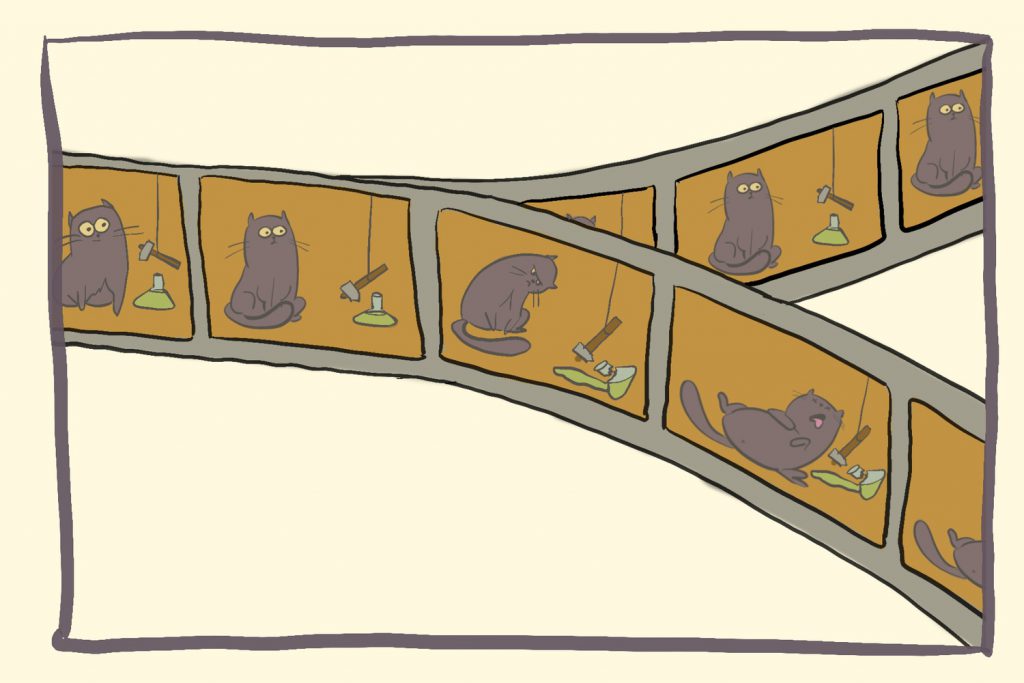
Scientists hypothesise that using a setup similar to that of Alice and Bob, it might be possible to test between the Copenhagen interpretation and the many-worlds interpretation. But for this, we need to achieve a macroscopic superposition. Scientists have long since achieved the superposition of microscopic particles experimentally; many IISc physicists do this regularly in their research. Current technology, however, has not been able to achieve macroscopic superposition. Yet.
An absurd, beautiful universe
But why is that? If quantum mechanics were the underlying framework of the universe, why aren’t such macroscopic superposition states found in real life? Theoretically, nothing is stopping us from making such exotic objects.
What if we made a cricket ball in a superposed state, existing in two different places, say Bengaluru and Delhi? Such a cricket ball will be defined by a wavefunction of more than 10²⁴ atoms (roughly the number of atoms in a cricket ball), which is constantly interacting with the environment. At such large scales, it is believed that the “quantumness” of objects dies out and gives us the usual, familiar classical physics. This phenomenon is called quantum decoherence. “How exactly classical physics arises from the underlying quantum reality of its atoms is something we still don’t know exactly. One of the pathways of explaining this is decoherence,” says Baladitya.
Very recently, however, scientists have come one step closer to realising a macroscopic superposition. In a study published in Nature in January 2026, researchers constructed a superposition state of a cluster of around 7,000 sodium atoms that are in two different positions at once. This is the closest we have ever come to macroscopic superposition.
Not only has the human race learned to live with quantum mechanics’ absurdity, but also made use of it in real life
With all its weirdness, quantum mechanics, to this day, remains an experimentally undefeated theory. Not only has the human race learned to live with its absurdity, but also made use of it in real life. Quantum computers, which use quantum effects to store and process information, promise to solve problems with a much higher efficiency than current classical computers. “Quantum technology essentially uses superposition, and thereby entanglement, as a resource,” says Baladitya, who works on quantum computation and superconducting qubits. Nanotechnology emerged as a field because of the exotic quantum behaviour observed in particles at such small scales.
Despite everything, we still do not know our beloved Meownstein’s exact fate, and the quest to reconcile quantum mechanics with our classical reality continues. There is so much about our quantum cat and the quantum world that we do not know. All we know is that we continue to live and learn in this quantum universe, a beautifully absurd universe.
Sayooj P is a third year Bachelor of Science (Research) student at IISc, and a science writing intern at the Office of Communications
(Edited by Rohini Subrahmanyam)