A day at DIGITS
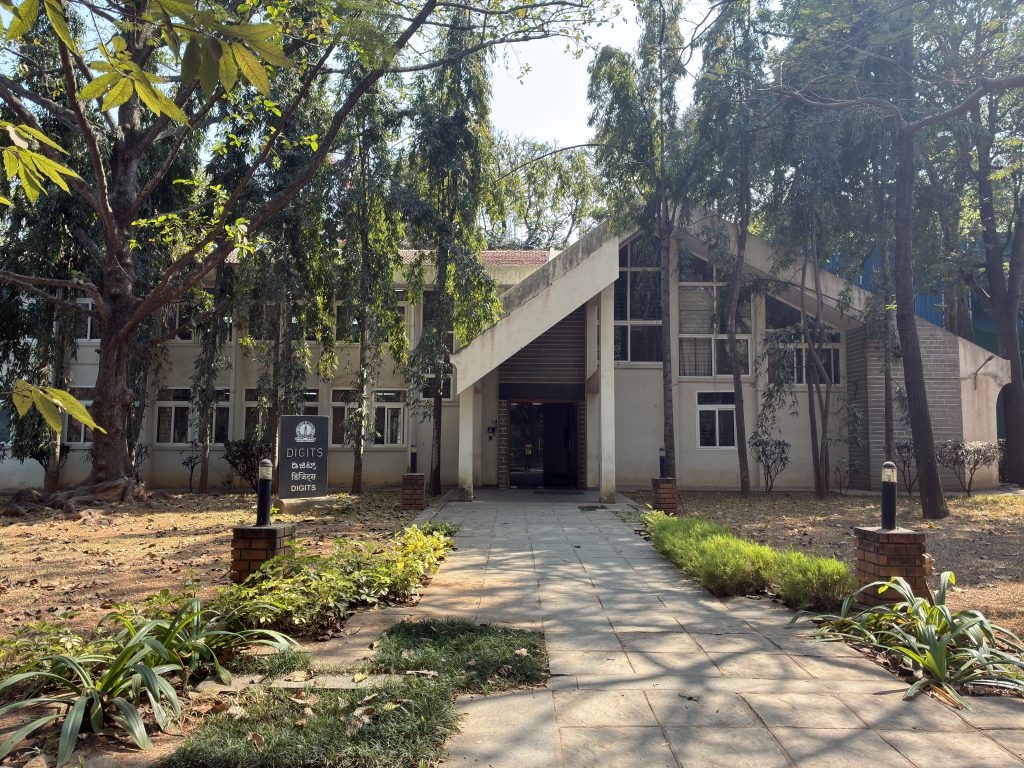
If IISc were a living organism, with the Main Building as its brain, then the DIGITS office (Digital Campus and Information Technology Services) would be its spine: positioned just behind the “brain”, tasked with carrying signals and coordinating responses across campus and beyond.
The office building stands at the intersection of Gulmohar Marg and Mahogany Marg, a modern structure crowned with a sloping rooftop and a garden decorated with Ashoka trees. Its central location is a sign of the office’s critical role on campus – holding up the Institute’s growing digital footprint.
On the inside, cubicles stretch in neat rows, desks bearing the signs of long-term occupancy – sticky notes on monitors, notebooks with tasks and reminders, diagrams on soft boards alongside family photos and doodles.
By the time the clock hits 10 am, office noises – phones ringing, keyboards clacking, notifications pinging – envelop the room alongside murmured conversations about website bugs, fixes, and Wi-Fi outages.
But before anyone settles in, the day begins with a small ritual: a stop at an office room on the ground floor to mark their attendance. That room belongs to AY Naaraayani, the administrative assistant of the DIGITS office, and Vinod Kumar, who manages office activities and procurement of all the departmental needs, including through the Government e-Marketplace and Naaraayani.
At the front desk
Naaraayani joined IISc in 2006, long before DIGITS existed, and worked across departments before assuming her current role. She has seen the office’s evolution, not just in its technology but also in its very structure. What began as small, disconnected units for digitalising the campus – CCA (Committee for Computerisation and Administration), CCIT (Committee for Computerisation and IT) and TINA (Telecom and Internet Access) – eventually came together under one roof as DIGITS in 2016, under the chairmanship of Yadati Narahari (now Honorary Professor at the Department of Computer Science and Automation). Narahari handed over the DIGITS Chair role to Anil Kumar in January 2021, who still holds the position, in addition to his role as the Dean, Administration and Finance, at IISc.
The intention was to centralise all digital communication technology and to support the Institute’s needs in this area. The department initially worked out of a single room in the erstwhile Choksi Hall, before finding its current home. “You can come here [DIGITS], get [all] your work done, and go. When new students join, they can easily get their email ID, network access, and SAP (Systems, Applications, and Products in Data Processing) ID set up, all in one place,” Naaraayani notes.
Many calls related to SAP, HR queries, network complaints, email problems, vendor follow-ups, and more come first to the office and are routed by Naaraayani to the concerned person or section. “Some days, there are 20-30 calls and emails,” she says. “Some days, there are very minimal. You cannot plan for it.”
Additionally, Naaraayani oversees the building’s day-to-day logistics, expenses, settling cash advances, and raising requests for hardware and other necessities. What would have been stacks of paperwork once is now easily handled digitally. Much of that shift has been enabled by SAP, the campus-wide system that connects workflows across departments.
Managing that system is the task of ISTAR (Implementation of SAP for Transforming the Administration and Research), located a few steps away from Naaraayani’s office.
Inside project ISTAR
Before the advent of SAP, connections between departments were fragile. Systems did not communicate. A student leaving a programme might be marked inactive in one database while still receiving payments from another. These details had to be manually cross-checked; errors and delays were inevitable.
To address this, DIGITS launched Project ISTAR, under which SAP was introduced as a unified system to support students, faculty members, and staff through a single, shared database, or a “single source of truth,” according to Anwesha Chakraborty, manager of the ISTAR core support team.
Implementation was a challenge. In its original form, SAP is a powerful but generic product. With CtrlS as a cloud service provider, Wipro was roped in to tailor it for the layered workflows of a research-intensive campus. The ISTAR team serves as the bridge between the campus, Wipro, and other support partners. “Departments often communicate their needs in business terms,” Anwesha explains. “Wipro speaks in a more technical language. Somebody is needed in between who can speak both languages to connect the two sides – translating business requirements into technical inputs and explaining technical constraints back to the departments in a way that they can easily understand.”
The rollout happened in two phases. The first, launched in June 2019, covered finance and accounts, sponsored projects, human resources and payroll, and stores and procurement. The second phase added academics, and hostel and mess management, which took more time as policies are prone to constant changes in these departments. It took nearly three years to complete campus-wide implementation.
Acceptance was not immediate. “The first thing that I heard from the user community was that it’s not intuitive at all,” Anwesha recalls. Over time, the ISTAR team reshaped the system – simplifying the interface and building an IISc-specific workflow, only to begin again as policies changed. “It is a constant cycle,” Anwesha admits.
What often goes unnoticed is the continuous daily effort … staying alert, troubleshooting quickly, and anticipating issues before they grow
The team’s job is to keep SAP’s most routine functions running smoothly – from raising local purchase orders and foreign procurements to academic course registrations – and being on the lookout for complaints or service requests on the SolMan portal (Solution Manager for SAP). What often goes unnoticed is the continuous daily effort behind this stability: staying alert, troubleshooting quickly, and anticipating issues before they grow. Technical glitches here can quickly turn into panic for campus users. At the same time, the team remains focused on continuous improvement, adding new features and refining existing ones to meet evolving campus requirements.
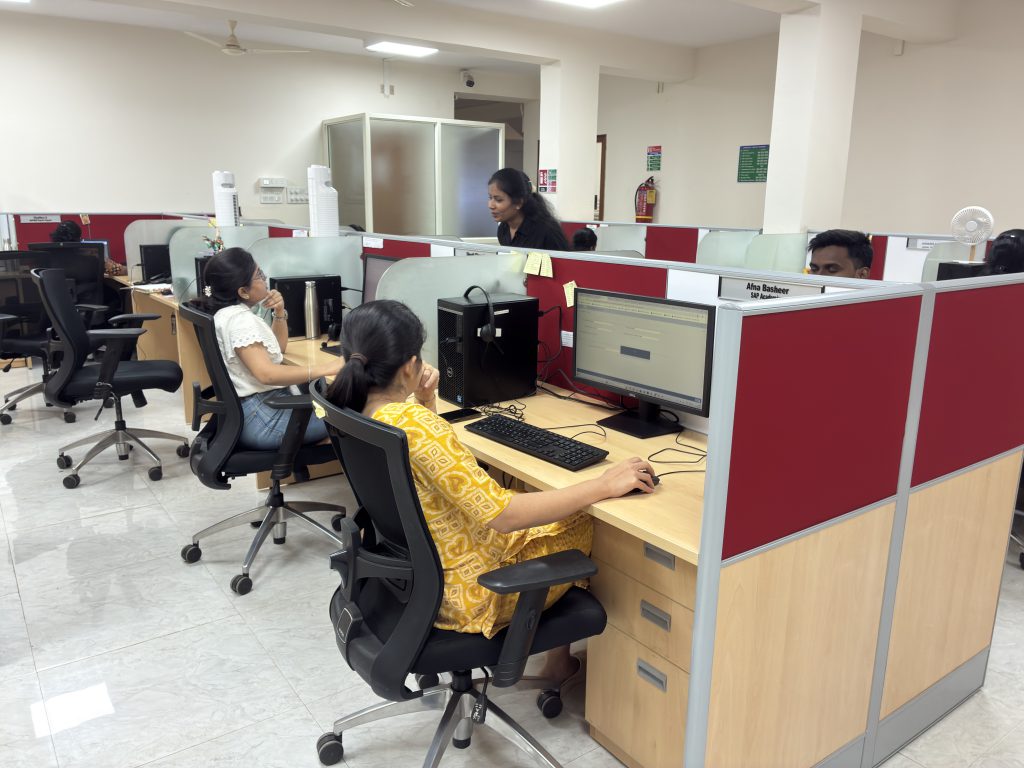
“People would come with their frustration, and we [have to] accept it,” Anwesha says. “We cannot be defensive.” The ISTAR team puts this into practice by guiding users through the interface when they face difficulties. To strengthen this support, ISTAR is undertaking a major project: migrating from the 2017 version of SAP to the latest 2025 release, which promises a more intuitive interface and improved ease of use. This transition will be led directly by SAP rather than Wipro, an evolution expected to accelerate the rollout and testing.
But keeping departmental workflows running requires a more basic requirement: connectivity. Up a flight of stairs is the team responsible for keeping the campus online.
Staying connected
On the first floor, in the right wing of the building, sits TINA, the Telecom and Internet Access group. This unit predates DIGITS, quietly improving network infrastructure, centralising email databases, and adding layers of security on communication systems.
Walking into this wing, one can find a ring of cubicles with monitors surrounding a central workbench holding spare router switches, Wi-Fi devices, and cables. The staff are separated into two units within TINA: Network and Hardware Support, and Email Support.
The team is led by Rahul Nair, who is rarely found at his desk. Instead, he is walking with a phone pressed to his ear, diving in and out of meetings, or out for a site visit on campus.
On a day which Rahul considers calm, his to-do list involved visits to the Centre for Neuroscience to plan new optic fibre routes, the Department of Electrical Communication Engineering for Wi-Fi upgrades, and the Interdisciplinary Sciences building to inspect damaged optic fibre cables. This is in addition to his many meetings and tasks within DIGITS.
At present, much of his attention is focused on a campus-wide Wi-Fi upgrade. The new routers being installed are expected to increase speeds from 70 Mbps to over 450 Mbps for older mobiles or laptops, and up to 1.3 Gbps for higher-end devices. Designing network infrastructure, Rahul insists, is not about planning for the average load but for peak traffic.
Currently, IISc has nearly 64 kilometres of optic fibre cables running underground, laid out in 12 interconnected rings with 24 termination points. On paper, it is robust. On the ground, it is constantly at odds with civil construction. Rahul notes how one of the underground fibres to the Division of Interdisciplinary Sciences building was cut during a dig-out and needed repair. In the same vein, the installation of new Wi-Fi routers becomes a challenge of optimisation. In the hostels, for example, the layout poses a problem – the placement of rooms in newer hostels, designed for improved privacy with staggered doors, has made them “not very Wi-Fi friendly.” The stone buildings are not helpful for Wi-Fi and 4G/5G mobile signals.
Network engineers at TINA monitor connectivity across the campus and respond when departments report internet or LAN failures, isolating issues that may stem from damaged cables, misconfigured switches, or deeper upstream problems.
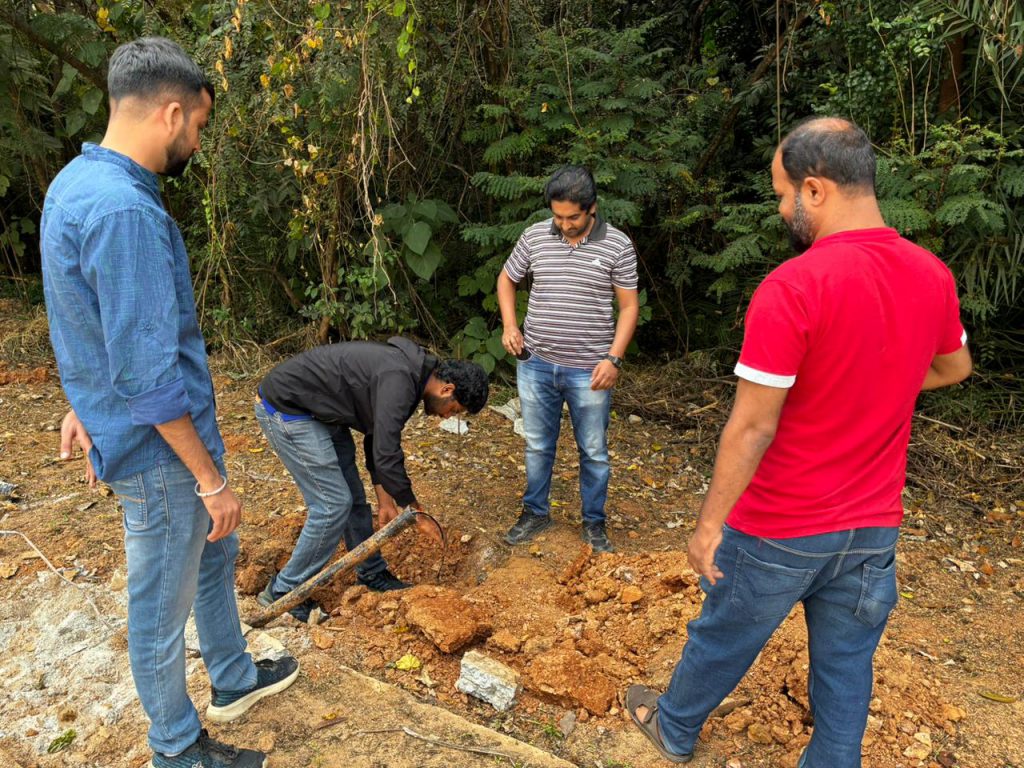
Alongside network support, TINA’s email team manages another critical layer of infrastructure: user accounts. From creation and maintenance to shared mailboxes and extensions, the team supports over 22,000 active accounts along with alumni accounts, a task made manageable by centralising previously fragmented ERNET domains under Microsoft 365. Email support is also a frontline defence against security threats.
One of the most visible changes fronted by the team was the rollout of multi-factor authentication (MFA) for email accounts. Before MFA, in one incident, nearly 900 phishing emails were sent one morning from a hijacked account; by the time the system intervened, 22 recipients had already clicked malicious links. After MFA, when a faculty member clicked a phishing link, the account was immediately disabled. “Even if the hacker had the credentials, they couldn’t do anything,” says Rahul. “You won’t believe the number of brute-force attacks we see.”
For years, cybersecurity at IISc was handled within TINA, but the rise of cyberattacks in recent years made it clear that security needed undivided attention. Thus came the Information Security Office (ISO), led by Joy Kuri, Professor at the Department of Electronic Systems Engineering and the Chief Information Security Officer. This team works across the corridor, in the left wing of the first floor.
The Information Security Office continuously monitors the campus network, automated systems flag suspicious activity, and every alert is checked manually
The ISO team continuously monitors the campus network, automated systems flag suspicious activity – connections to malicious websites, abnormal traffic, infected downloads – and every alert is checked manually. When needed, the team contacts users directly, cleans compromised systems, and, in rare cases, temporarily cuts off network access to contain risk.
A new website or service under the iisc.ac.in domain must first pass Vulnerability Assessment and Penetration Testing (VAPT) conducted by the ISO team. Weaknesses identified by thorough scans are reported and fixed, and only then is the website cleared to go live.
With security embedded into every new service before it goes live, the focus shifts from protection to creation. On the same floor, the software development team takes on the task of building the portals, websites and maintaining the cloud infrastructure that the campus depends on.
Custom portals
The software development team, hired from Integra Micro Software Services (an external technology partner), has worked with IISc for nearly a decade. The team is led by Robin T Daniel.
A wide range of campus processes that operate within departments require custom-built portals to formalise workflows or collect data digitally. For instance, the receipts portal serves as IISc’s payment gateway for all payment transactions. Earlier, departments hosting conferences, events or seminars had to coordinate separately with the finance office to create a debit head and rely on third-party websites to collect and track paid registrations. The receipts portal eliminates these steps by providing an interface that allows end users to make payments directly. The team maintains over 120 applications, some of them built by DIGITS.
One of the largest ongoing efforts is the new Admissions Management System. It is designed to manage admissions to all types of programmes centrally, eliminating the need to maintain multiple platforms for various sessions and applicant groups. The applicant-facing portal has gone live and is accessible globally, while internal portals support academic offices and departments in managing interviews, selections, and document verification.
“In projects like the Admissions Management System (AMS), clarity grows as we build. Requirements can evolve mid-way, so the real challenge is responding thoughtfully – absorbing new complexity without losing pace or quality,” Robin says.
‘The period before a go-live is when the team becomes most aligned – developers, testers, and the Committee working closely, double-checking every detail’
“The period before a go-live is when the team becomes most aligned – developers, testers, and the Committee working closely, double-checking every detail. That shared focus and responsibility is genuinely meaningful to me,” he adds.
Moments like these reflect how DIGITS functions as a whole. From the ground floor, where requests first arrive and are routed, to the teams maintaining SAP, campus networks, security, and portals – the department is a linked system. Each team absorbs its own pressures, but the work only holds together through coordination.
Seated in the same left wing of the office is Harikrishnan Muthalanghat, a Senior Technical Consultant who has been working at DIGITS since July 2014. He is responsible for managing the ScholarOne Thesis Processing System. “The work includes maintenance, providing support to students, Deans, and caseworkers, and also generating periodic status reports,” he shares.
He also handles maintenance and user support for Google Workspace (formerly known as G Suite), a cloud-based suite integrating multiple Google applications through a unified gateway system, and manages the SharePoint-based intranet system, which functions as a centralised gateway to multiple information portals of IISc.
Keeping the spine aligned
At the centre of DIGITS’ operations is the Chief Information Technologist, Srinivas Anand Rao. If individual teams keep systems running, Srinivas’ responsibility is to ensure it all makes sense as a whole: technically, financially, and administratively.
Much of Srinivas’ work involves navigating a rapidly shifting technology landscape. For instance, the campus is heavily dependent on Microsoft’s services and large storage benefits. A recent change in Microsoft’s storage policy dramatically reduced cloud space allocations (from 1 TB to 100 GB) and increased costs. What was once a predictable dependency is now a financial decision. “We cannot afford to continue in one domain blindly. We have to continuously look at alternatives,” he says.
Srinivas also deals with vendor negotiations, license renewals, purchase orders, and committee approvals. Licensing models that were once life-long are now subscription-based, demanding frequent justification for renewal. Such procurements must pass through multiple levels of approval, including the DIGITS Purchase Committee. “If Microsoft changes a policy, I have to explain not just what changed, but why we are continuing with them, what alternatives exist, and what value the Institute is getting,” he says.
Procedural delays are inevitable. Over time, trust and familiarity have enabled such approvals to move faster. “My biggest asset here is my relations with people now. For example, we were able to release the last Microsoft purchase order in two working days with a lot of changes,” he admits.
‘Over the last couple of years, DIGITS has taken on many additional responsibilities, and the team has grown in size and capabilities’
Beyond managing the present, Srinivas emphasises on the long-term sustainability of the department. “Over the last couple of years, DIGITS has taken on many additional responsibilities, and the team has grown in size and capabilities,” he says. There is a deliberate effort to build a better workplace culture, where staff welfare, engagement, and upskilling are essential. “Attrition is a concern,” notes Srinivas, pointing to DIGITS’ emphasis on bringing critical work in-house. “It may not give immediate benefits, but over time, we will be able to self-sustain.”
Most of the work at DIGITS is unseen, although it is what keeps the Institute functioning smoothly. The campus population probably never thinks about DIGITS when things are working as they should be. That invisibility is the department’s greatest success and its heaviest burden.
“It is a challenge for any support department to be noticed at all when things go smoothly, but it will be the first one to be noticed when something doesn’t go well,” Srinivas reflects.
And yet, every day, DIGITS holds these systems together, quietly keeping the Institute’s digital spine aligned. Even when the lights dim and the last stragglers pack up for the day, the servers continue to run. Somewhere on campus, someone is always about to click ‘submit’ with near certainty that the system will work.
Almost always, it does.
Shravani Deoghare is a fourth year Bachelor of Science (Research) student at IISc and a science writing intern at the Office of Communications
(Edited by Sandeep Menon, Abinaya Kalyanasundaram)